
Cart
Your cart is empty, but doesn't have to be..
Your cart is empty, but doesn't have to be..
Rosén Innovation COM |3/08, 2026
lift pads must protect the vehicle while transmitting load safely through the correct lifting point. Polyurethane pads are widely used because they can combine high load support with controlled surface protection. Yet the right pad must match the lift arm, adapter, vehicle lifting point, and service conditions. An incorrect fit can create instability regardless of material quality.
For anti-fatigue matting, rubber often remains highly relevant because personnel comfort, traction, and floor conformity are central requirements. Polyurethane mats can be appropriate where wear resistance, edge durability, or specific cleaning requirements are more demanding. In food, healthcare, or industrial washdown settings, the cleaning routine and slip requirements should guide the selection.
For warehouse and forklift safety blocks, polyurethane can offer a useful balance of strength and low handling weight. Where blocks contact painted surfaces, tires, or floors, hardness and geometry should be selected to avoid damage. The safest option is the one rated and shaped for the specific equipment, not the heaviest block in the storage area.
Material is one line in a specification. Buyers should also verify dimensions, rated capacity, hardness where relevant, contact geometry, temperature limits, chemical exposure, visibility requirements, and storage conditions. For safety-critical items, product instructions and site procedures must remain the final authority.
Rosén Innovation develops and manufactures polyurethane products in Sweden for applications where weight reduction, strength, daily handling, and recyclability matter. That focus is especially relevant for aircraft chocks, lift pads, safety blocks, and industrial wear products, where a well-engineered shape can be as important as the polymer itself.
If the job calls for flexible grip and cushioning, rubber may be the practical answer. If it calls for high load capacity, long wear, low weight, and precise molded performance, polyurethane may be the better fit. Start with the equipment and working environment, then select the product that helps your team work safely shift after shift.
">
A wheel chock that is easy to carry but shifts under load is a safety problem. A lift pad that survives contact with oil but marks a vehicle frame is an expensive problem. In the polyurethane versus rubber decision, the right material is not the one with the best general reputation. It is the one that matches the load, contact surface, environment, handling requirements, and replacement cycle of the job.
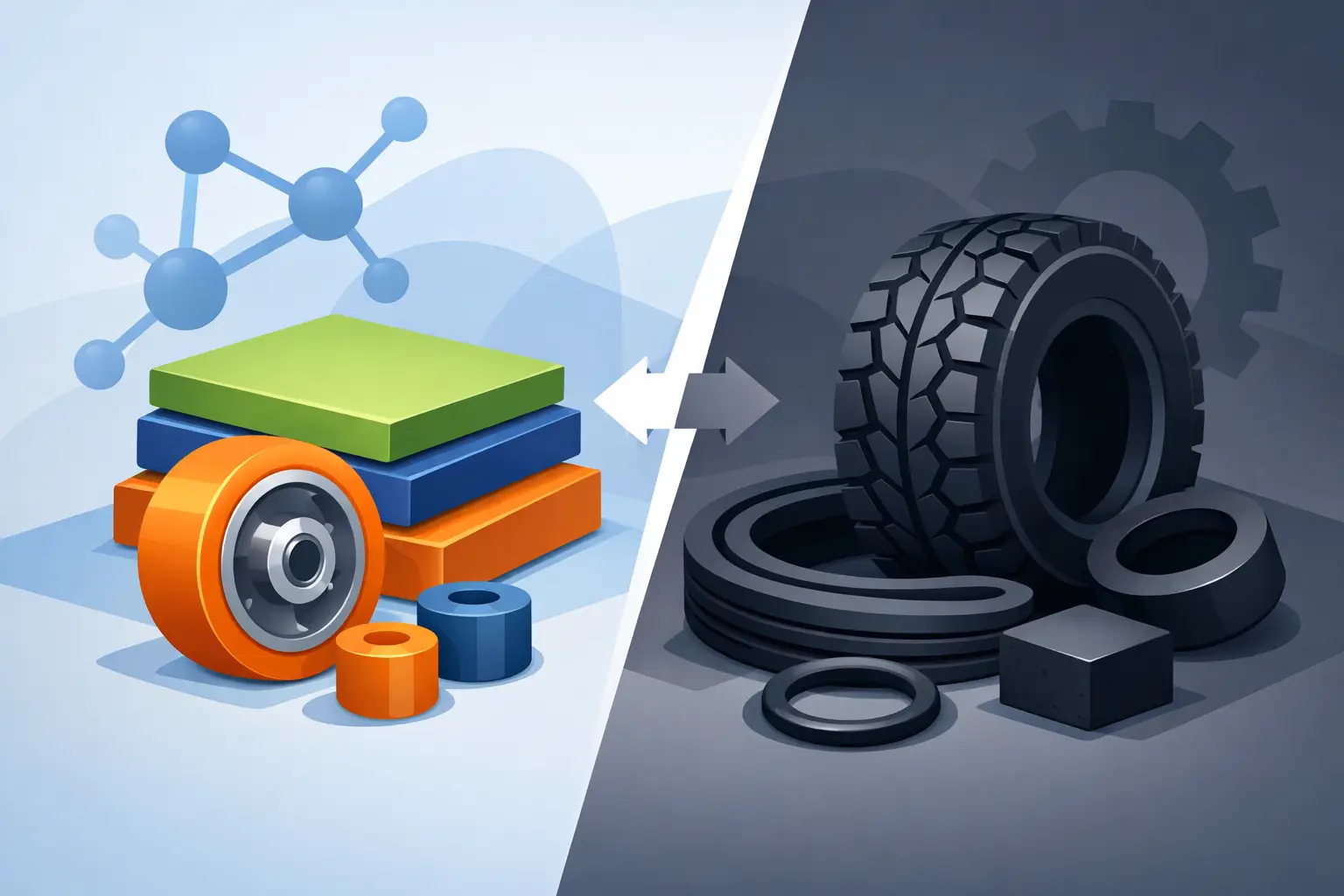
For aviation ramps, workshops, warehouses, and facilities, both materials have a place. Rubber remains a proven choice for grip and vibration control. Polyurethane can deliver high load capacity, lower handling weight, long wear life, and precise molded geometry. The material selection should begin with the application, not with a generic claim that one is always better.
Rubber is a broad family of materials, including natural rubber, nitrile, EPDM, neoprene, and other formulations. Their performance can vary widely. Polyurethane is also formulated in different ways, with hardness, rebound, chemical resistance, and flexibility adjusted for the intended product. Comparing an unspecified polyurethane part with an unspecified rubber part can therefore lead to the wrong purchasing decision.
For a fair comparison, define the working conditions first. Consider the supported weight, the size and shape of the contact area, whether the part will slide or remain fixed, exposure to oils or weather, temperature range, and how often personnel must move it. A stationary mat and an aircraft wheel chock may both touch the ground, but they demand very different material behavior.
Industrial polyurethane is often selected when a component must carry high repeated loads without becoming unnecessarily large or heavy. Its high abrasion resistance is useful where material sees repeated contact, rolling, dragging, or impact. This makes it a practical choice for aircraft wheel chocks, forklift safety blocks, vehicle-lift pads, wear components, and road-safety elements.
Weight matters more than it may appear on a specification sheet. Ramp personnel and technicians handle chocks and blocks repeatedly through a shift. A lighter polyurethane design can reduce physical strain while still providing the strength required for the equipment being secured. Lower product weight can also reduce shipping and storage burden, especially for fleets, ground handlers, and resellers ordering in quantity.
Polyurethane can be molded to exact shapes with integrated handles, angled contact faces, ribs, openings, or identification features. That design freedom helps manufacturers create products that fit wheel profiles, lift points, and operational handling procedures instead of relying on a basic block shape. In safety equipment, fit and usability are part of performance.
Many polyurethane formulations also perform well around oils, grease, fuel splash, and common workshop contaminants. That does not mean every polyurethane product is compatible with every chemical. Buyers should confirm the intended exposure with the product specification, particularly where solvents, concentrated chemicals, or continuous fluid contact are involved.
A further consideration is end-of-life handling. Certain polyurethane products can be designed for recycling, supporting purchasing programs that aim to reduce waste from frequently used industrial consumables. For operations looking for lighter, stronger, safer, and recyclable alternatives, this is a meaningful advantage when matched with the correct product design.
Rubber is often the better choice when surface grip, softness, vibration damping, or broad floor contact is the priority. Anti-fatigue mats are a clear example. A well-designed rubber mat can provide a comfortable, stable standing surface that helps reduce strain for personnel at workstations, service counters, production lines, and machine areas.
Rubber also works well where a compliant surface is needed to protect delicate finishes or accommodate irregular floors. Its elastic behavior can help it conform to the contact surface and absorb movement. In some applications, particularly wet-floor or vibration-control environments, that flexibility is more valuable than polyurethane's higher load-bearing efficiency.
Outdoor durability depends on the rubber compound. EPDM, for example, is commonly selected for resistance to weathering, ozone, and UV exposure. Nitrile rubber is often chosen where oil resistance matters. Natural rubber can offer excellent elasticity and grip but may be less suitable for some chemical or weather exposures. The key point is simple: asking for “rubber” is not specific enough for a demanding industrial application.
A procurement decision becomes easier when the part is assessed against real use conditions rather than material names alone.
Load and compression: For concentrated loads, vehicle lifting points, and wheel restraint, polyurethane can provide strong support in a compact form. Rubber may compress more under load, which is useful for cushioning but can be a drawback where dimensional stability and clearance matter. Check the rated capacity and the manufacturer’s intended use, not only the material hardness.
Grip and movement: Rubber commonly provides strong traction on many floors and can be effective where slip resistance is the first concern. Polyurethane can also be formulated for grip, but tread geometry, surface texture, moisture, and contamination can have as much influence as the base material. A chock must be selected as a complete safety product, with wheel size, slope, vehicle weight, and operating procedure considered together.
Wear and repeated handling: Polyurethane frequently performs well against abrasion, cuts, and repeated contact. This can make it cost-effective for high-use parts even when the initial purchase price is higher. Rubber can also offer good service life, but softer grades may wear faster in abrasive or high-friction conditions.
Oil, fuel, and chemicals: There is no universal winner. Some polyurethane and rubber compounds resist specific fluids very well; others do not. Workshop teams should identify the actual fluids present, including hydraulic oil, lubricants, cleaners, de-icers, and fuel, then verify compatibility before ordering.
Weather and temperature: Outdoor use calls for attention to UV, rain, ice, heat, and temperature cycling. Rubber compounds such as EPDM may be a strong choice for exposed weather conditions. Polyurethane can perform well outdoors too, but formulation and application design remain critical. In very cold environments, impact behavior and flexibility should be confirmed rather than assumed.
Handling and ergonomics: If operators carry the product dozens of times per day, weight and grip points are operational safety features. Lightweight polyurethane chocks and blocks can reduce repetitive lifting effort. For standing work, the comfort and cushioning of a properly selected rubber or polyurethane anti-fatigue mat may matter more than the material’s theoretical strength.
For aircraft wheel chocks, polyurethane is often a strong solution because the equipment needs to be durable, visible, manageable by ramp crews, and capable of repeated use. The correct chock size and configuration still depend on aircraft tire diameter, aircraft type, pavement conditions, and the operator’s safety procedures. A chock is not interchangeable simply because it is made from a high-performing material.
For vehicle lifts, lift pads must protect the vehicle while transmitting load safely through the correct lifting point. Polyurethane pads are widely used because they can combine high load support with controlled surface protection. Yet the right pad must match the lift arm, adapter, vehicle lifting point, and service conditions. An incorrect fit can create instability regardless of material quality.
For anti-fatigue matting, rubber often remains highly relevant because personnel comfort, traction, and floor conformity are central requirements. Polyurethane mats can be appropriate where wear resistance, edge durability, or specific cleaning requirements are more demanding. In food, healthcare, or industrial washdown settings, the cleaning routine and slip requirements should guide the selection.
For warehouse and forklift safety blocks, polyurethane can offer a useful balance of strength and low handling weight. Where blocks contact painted surfaces, tires, or floors, hardness and geometry should be selected to avoid damage. The safest option is the one rated and shaped for the specific equipment, not the heaviest block in the storage area.
Material is one line in a specification. Buyers should also verify dimensions, rated capacity, hardness where relevant, contact geometry, temperature limits, chemical exposure, visibility requirements, and storage conditions. For safety-critical items, product instructions and site procedures must remain the final authority.
Rosén Innovation develops and manufactures polyurethane products in Sweden for applications where weight reduction, strength, daily handling, and recyclability matter. That focus is especially relevant for aircraft chocks, lift pads, safety blocks, and industrial wear products, where a well-engineered shape can be as important as the polymer itself.
If the job calls for flexible grip and cushioning, rubber may be the practical answer. If it calls for high load capacity, long wear, low weight, and precise molded performance, polyurethane may be the better fit. Start with the equipment and working environment, then select the product that helps your team work safely shift after shift.