
Cart
Your cart is empty, but doesn't have to be..
Your cart is empty, but doesn't have to be..
Rosén Innovation COM |19/07, 2026
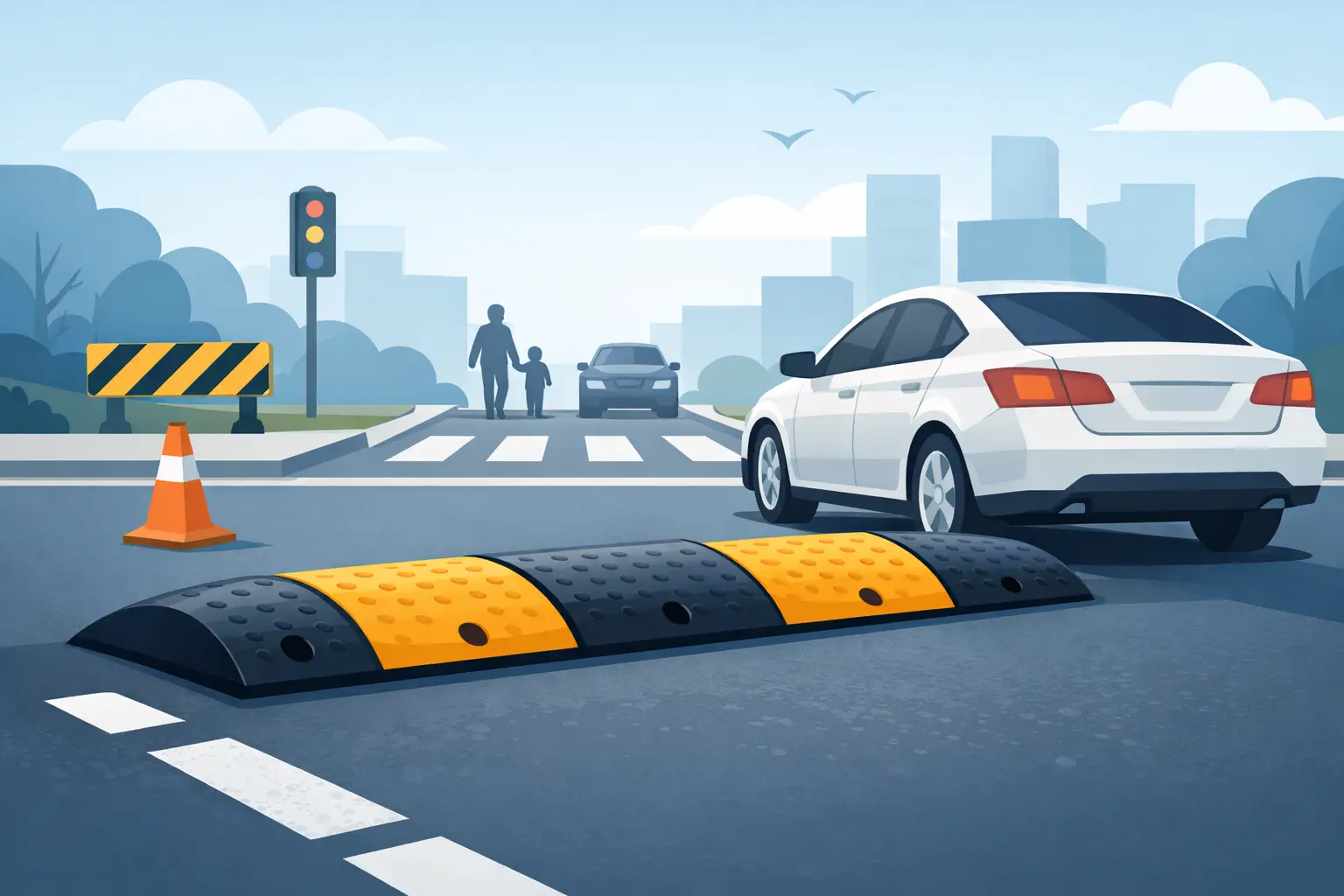
Temporary barriers and clear routing are necessary while anchors cure, tools are in use, or traffic lanes are partially closed. Scheduling the work outside peak delivery or shift-change periods reduces disruption and gives the team time to complete the job accurately.
Rubber speed bumps require less maintenance than many permanent alternatives, but they are not fit-and-forget equipment. Include them in regular facility inspections, especially after winter weather, resurfacing work, heavy deliveries, or snow removal.
Check for loose anchors, split sections, worn reflective areas, missing end caps, and debris buildup along the edges. Standing water can hide damage and contribute to surface deterioration, so drainage should remain clear. If a section shifts, address it promptly. Small movement can enlarge mounting holes and turn a simple repair into a larger pavement issue.
Cleaning is generally straightforward. Remove dirt, gravel, oil residue, and compacted snow using methods that will not damage the material or pull at the anchored edges. In facilities with chemical exposure, confirm that the selected material is compatible with the substances used on site. The best speed bump for a dry parking lot may not be the best choice for a workshop entrance exposed to oils, cleaning agents, or frequent washdown.
Rubber is a strong choice when fast installation, modular sizing, and practical replacement are priorities. It provides a resilient crossing surface and can be easier to handle than heavy concrete components. For many private facilities, those benefits make rubber speed bumps a sensible balance of performance and operational convenience.
Polyurethane alternatives can be worth considering where low weight, high strength, and long-term material durability are central requirements. A professionally specified polyurethane traffic-control product may also align with organizations seeking recyclable material solutions. Concrete or asphalt humps, meanwhile, can suit permanent civil works but require more planning, curing time, and disruption when layouts change.
The correct choice depends on the traffic environment. A small office parking area, a distribution center, and an aircraft service zone should not be specified from the same checklist. Match the material and profile to real vehicle movements, daily loads, environmental exposure, and the safety objective at that exact location.
For buyers managing several sites, standardizing approved dimensions, colors, anchor types, and inspection routines can simplify procurement and maintenance. Rosén Innovation applies the same practical material focus across workplace and road-safety equipment: select for the job, install correctly, and keep the product visible and secure. A well-chosen speed bump does not need to be complicated. It simply needs to make the safe choice - slowing down - the obvious one.
">
A delivery van cuts through a warehouse yard, a forklift crosses a shared lane, and pedestrians step out from behind stacked materials. That is where rubber speed bumps earn their place. They create a physical reminder to slow down where painted signs alone are easy to miss, helping facility teams control vehicle speed without permanently rebuilding the surface.
For professional buyers, the right product is not simply the tallest bump available. It is a question of traffic speed, vehicle type, axle loads, pavement condition, visibility, and the level of disruption the site can accept. A speed-control measure that is too aggressive can damage loads, frustrate drivers, and create maintenance issues. One that is too low or poorly positioned may not change driver behavior at all.
Rubber speed bumps are best suited to controlled, lower-speed environments: parking areas, private roads, loading zones, commercial properties, campuses, gated communities, and industrial facilities. They are particularly useful where cars, vans, forklifts, service vehicles, and pedestrians share space.
Their modular construction is a practical advantage. Sections can be carried into position, assembled to suit the lane width, and anchored to asphalt or concrete. If a traffic pattern changes, the installation can often be modified or relocated without the demolition work associated with poured concrete. This flexibility matters in facilities where entrances, parking layouts, or work zones change over time.
They are not a substitute for road engineering on high-speed public routes. Where traffic approaches at higher speeds, a speed bump alone can be an inadequate and potentially unsafe response. Signs, pavement markings, sightlines, lighting, lane design, and local traffic requirements all need to work together. On public roads, always verify the applicable authority requirements before specifying or installing any traffic-calming product.
Start with the vehicles that cross the location every day, not only the occasional vehicle. A passenger-car parking lot has different requirements than a logistics yard handling loaded delivery trucks, forklifts, or ground-support equipment.
A taller profile produces a stronger speed-reduction effect, but it also increases impact. For a low-speed parking area, a moderate profile may be enough to encourage careful driving while keeping the crossing comfortable. In a pedestrian-priority zone or near a blind corner, a more pronounced profile may be appropriate if vehicle speeds are already very low.
Do not use height as the only specification. The shape and length of the ramp matter because they determine how gradually a tire climbs and descends. A broader, more gradual profile is usually better for sites where vehicles carry sensitive loads or where a harsh impact would create unnecessary strain on drivers and equipment.
A speed bump should provide a consistent signal across the route drivers actually use. If it is too narrow for a wide entrance or if vehicles can easily pass around the ends, it will not reliably control speed. Measure the traveled lane, account for curbs and drainage, and allow for safe clearance where needed.
Modular rubber sections make it possible to build the required width rather than settling for a fixed length. End caps are useful at exposed edges because they create a more finished transition and reduce sharp corners that may be struck by tires or foot traffic.
Material quality and anchoring are just as important as dimensions. A bump exposed to repeated heavy vehicle traffic needs sufficient strength, stable geometry, and secure fastening. Weak fasteners or an uneven mounting surface can lead to movement, lifted edges, and early failure.
Inspect the pavement before installation. Cracked asphalt, loose concrete, deep ruts, or poor drainage can prevent a stable fit. Repairing the surface first is usually less expensive than repeatedly replacing anchors or repositioning a product that cannot sit flat. Select anchors designed for the substrate, and make sure the fastening pattern suits the anticipated traffic load.
Drivers need enough time to recognize a speed-control device and slow down smoothly. High-contrast yellow and black sections are common because they stand out against asphalt and concrete. Reflective elements can add useful visibility in dim parking structures, early-morning loading operations, or poorly lit access roads.
Visibility should extend beyond the bump itself. Use appropriate advance warning signs, pavement markings where suitable, and adequate lighting. At a busy industrial site, drivers may be watching for pedestrians, reversing vehicles, dock doors, and forklifts. The more clearly the route communicates the need to slow down, the less likely drivers are to brake sharply at the last moment.
Placement should also respect sightlines. Avoid locating a bump immediately after a blind turn where a driver has no chance to react. Keep it clear of drainage paths, vehicle scales, door thresholds, and areas where a stopped vehicle would block an emergency route. In a warehouse yard, install it far enough from loading bays that trucks can stabilize before maneuvering into position.
A clean installation starts with measuring the route and marking the final position before drilling. Lay out the modules on the surface, confirm the assembled width, and check that end caps and connectors are aligned. If the product includes preformed mounting points, use them as intended rather than adding random fasteners that may weaken the sections.
The installation team should clean the surface thoroughly and remove debris from drilled holes before setting anchors. After fastening, check every section for movement and confirm that the transitions are level. A loose edge can become a trip hazard or catch a tire, especially when vehicles turn across the product rather than crossing it squarely.
For sites that remain operational during installation, control the work area properly. Temporary barriers and clear routing are necessary while anchors cure, tools are in use, or traffic lanes are partially closed. Scheduling the work outside peak delivery or shift-change periods reduces disruption and gives the team time to complete the job accurately.
Rubber speed bumps require less maintenance than many permanent alternatives, but they are not fit-and-forget equipment. Include them in regular facility inspections, especially after winter weather, resurfacing work, heavy deliveries, or snow removal.
Check for loose anchors, split sections, worn reflective areas, missing end caps, and debris buildup along the edges. Standing water can hide damage and contribute to surface deterioration, so drainage should remain clear. If a section shifts, address it promptly. Small movement can enlarge mounting holes and turn a simple repair into a larger pavement issue.
Cleaning is generally straightforward. Remove dirt, gravel, oil residue, and compacted snow using methods that will not damage the material or pull at the anchored edges. In facilities with chemical exposure, confirm that the selected material is compatible with the substances used on site. The best speed bump for a dry parking lot may not be the best choice for a workshop entrance exposed to oils, cleaning agents, or frequent washdown.
Rubber is a strong choice when fast installation, modular sizing, and practical replacement are priorities. It provides a resilient crossing surface and can be easier to handle than heavy concrete components. For many private facilities, those benefits make rubber speed bumps a sensible balance of performance and operational convenience.
Polyurethane alternatives can be worth considering where low weight, high strength, and long-term material durability are central requirements. A professionally specified polyurethane traffic-control product may also align with organizations seeking recyclable material solutions. Concrete or asphalt humps, meanwhile, can suit permanent civil works but require more planning, curing time, and disruption when layouts change.
The correct choice depends on the traffic environment. A small office parking area, a distribution center, and an aircraft service zone should not be specified from the same checklist. Match the material and profile to real vehicle movements, daily loads, environmental exposure, and the safety objective at that exact location.
For buyers managing several sites, standardizing approved dimensions, colors, anchor types, and inspection routines can simplify procurement and maintenance. Rosén Innovation applies the same practical material focus across workplace and road-safety equipment: select for the job, install correctly, and keep the product visible and secure. A well-chosen speed bump does not need to be complicated. It simply needs to make the safe choice - slowing down - the obvious one.