
Cart
Your cart is empty, but doesn't have to be..
Your cart is empty, but doesn't have to be..
Rosén Innovation COM |15/07, 2026
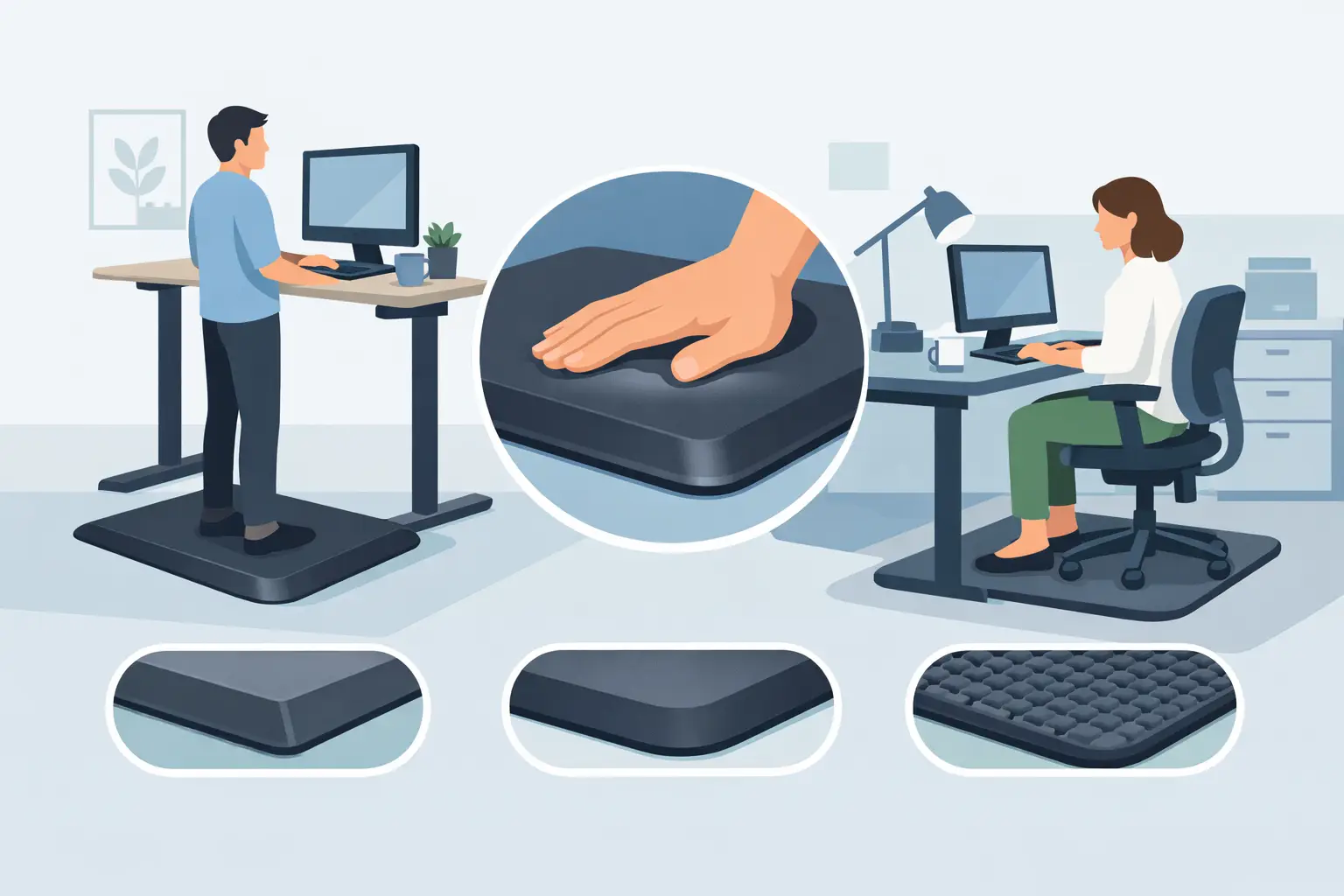
Polyurethane is a strong option where buyers need low weight, long service life, and resilient cushioning. Properly engineered polyurethane can retain its supportive properties well under repeated daily use while remaining easier to handle than heavy rubber alternatives. It is particularly relevant for workstations where staff stand for long periods and the mat needs to be moved for cleaning or reconfiguration.
For operations focused on material efficiency, recyclable polyurethane is also worth considering. End-of-life handling should not be an afterthought for facilities that replace equipment across multiple sites. Rosén Innovation develops Swedish-made polyurethane workplace products around this combination of strength, low weight, ergonomic function, and recyclability.
Rubber mats are often chosen for their grip, weight, and resistance in tougher industrial environments. They can be a practical choice in areas exposed to moisture or where a heavier mat is less likely to shift during use. The trade-off is handling weight and, depending on the rubber compound, potential sensitivity to particular oils, fuels, or cleaning agents.
Do not assume that "rubber" means chemical-proof. Verify the intended exposure. A mat that performs well in a dry maintenance bay may not be appropriate beside a wash station or in a process area with aggressive fluids.
Textured surfaces help maintain traction when workers pivot, reach, or carry components. Raised patterns can improve footing, but they also collect dust, debris, and liquid if the area is not cleaned regularly. Smooth surfaces are easier to wipe down, while more pronounced textures may be better in wet or dirty areas.
The correct surface is the one that supports safe footing and realistic housekeeping. If an area cannot be cleaned frequently, avoid a pattern that traps contaminants in hard-to-reach recesses.
A mat should support the task without creating an obstruction. For a single fixed position, measure the worker's normal foot placement and allow room for natural shifting. For a bench, packing table, or assembly line, measure the complete active length rather than buying several small mats that can separate or migrate.
Thickness requires balance. More thickness can improve cushioning, but excessive softness can feel unstable during precision work or when employees step on and off the mat repeatedly. A thinner, denser mat may be the better choice for a workstation requiring frequent foot movement, while a more cushioned design can suit a static standing position.
Edges deserve the same attention. Beveled edges reduce the abrupt height change between the mat and floor, helping reduce trip risk and making access easier for rolling equipment. Check that the edges remain flat after installation. Curling corners or damaged borders should be addressed immediately, not left until the next planned facility inspection.
In automotive workshops, place mats where technicians spend the most stationary time: service benches, diagnostic stations, parts cleaning areas, and tool cabinets. Avoid placing them where they interfere with rolling jacks, creepers, or lift arms. Where oil and fluids are present, select a material rated for that environment and establish a cleaning routine.
In warehouses and fulfillment operations, mats work well at packing benches, label-printing stations, inspection tables, and return-processing counters. They are less suitable in active forklift lanes or beneath pallet movement routes unless designed specifically for that traffic. Keeping the mat within the defined work zone helps preserve both pedestrian and vehicle safety.
For manufacturing, consider the full sequence of work. If an operator moves between a control panel, a fixture, and a component rack, a runner or linked layout may offer better coverage than a single square mat. In wet-process, food-service, or healthcare environments, hygiene and drainage requirements may outweigh cushioning thickness.
At reception counters, security desks, laboratories, and clinical workstations, appearance can matter alongside fatigue reduction. A clean, low-profile mat with stable edges may be preferable to a heavily textured industrial design. The mat still needs to withstand the cleaning products used by the facility team.
Even a high-quality mat can become a safety issue if installed on a dirty, uneven, or wet floor. Clean and dry the area first, then lay the mat flat and allow it to settle before use. Do not cover floor damage, loose tiles, or uneven concrete with a mat in place of repair. The underlying issue remains.
Set a simple inspection routine. Look for compression that does not recover, cracks, torn edges, curling corners, loss of grip, and contamination that cannot be cleaned away. Replace mats before their condition creates a trip hazard or reduces ergonomic performance.
Cleaning should match the material and exposure. In many applications, regular sweeping followed by mild detergent and water is sufficient. Avoid solvents or harsh chemicals unless the material specification confirms compatibility. A mat that is clean, dry, and flat performs better and presents a more professional workstation to employees, inspectors, and customers.
The lowest unit price is rarely the lowest operating cost. A cheap mat that compresses early, shifts on the floor, or requires frequent replacement creates more purchasing work and more disruption than a durable option. Consider expected service life, cleaning time, replacement frequency, employee exposure hours, and the cost of maintaining a safe work area.
Bulk procurement can make sense for multi-station workshops, production lines, and facility rollouts, but standardization should not mean forcing one mat into every environment. Use a limited number of proven specifications for dry stations, wet areas, and high-exposure work zones. That keeps ordering simple while preserving the right fit for each application.
A well-selected mat is a small piece of equipment with a direct effect on how a workstation feels at hour eight, not just at the start of the shift. Specify it for the floor, the task, and the worker's movement pattern, then keep it clean and in good condition. That is how standing comfort becomes a practical part of everyday operational safety.
">
A technician standing at a vehicle lift, a ramp agent working around ground-support equipment, and a packing operator at a warehouse bench all face the same physical problem: hard flooring transfers the load of prolonged standing directly into the feet, legs, hips, and lower back. The right ergonomic mats create a more forgiving work surface without compromising stable footing, cleaning requirements, or the movement of equipment.
For professional buyers, this is not a minor comfort upgrade. Fatigue can affect pace, concentration, posture, and the likelihood of slips or poor lifting technique over a full shift. A mat must therefore be selected as workplace equipment, with the same attention given to load, environment, dimensions, and material compatibility.
An anti-fatigue mat provides controlled cushioning beneath the worker's feet. That small amount of movement encourages subtle muscle activity and reduces the constant pressure associated with standing on concrete, tile, steel decking, or other hard industrial floors. The goal is not a soft, unstable surface. It is a stable platform that reduces fatigue while allowing employees to work precisely and safely.
Material matters because the mat must maintain that support through repeated compression. A mat that quickly flattens may look acceptable at first but provides less benefit over time. It can also create worn edges, trip points, and an uneven surface that is difficult to clean.
In workshops, production areas, reception points, healthcare stations, and packing lines, ergonomic mats can also protect the floor underneath from dropped tools, minor impacts, and scuffing. That is useful, but floor protection should be considered a secondary benefit. The primary requirement is reliable standing comfort under the actual conditions of the job.
The fastest way to choose incorrectly is to buy based on a general description such as "anti-fatigue" or "industrial." Start by mapping the work position instead. Identify where the employee stands, how often they turn or step away, what lands on the floor, and whether wheeled equipment crosses the area.
A fixed assembly station may need a long runner that covers the full movement zone. A machine operator may need a compact mat positioned at the control side of the equipment. At a workbench, the mat should cover the normal standing stance plus the reach area for frequently used tools. If workers repeatedly stand with one foot partly off the mat, the size is wrong regardless of how good the material is.
Also consider transition points. Mats placed in doorways, narrow walkways, or routes used by carts and pallet jacks need particular care. Thick cushioning can be valuable for stationary work, but it may be unsuitable where wheels must cross frequently. In those locations, low-profile edges, beveled borders, or a different floor solution may be the better safety decision.
Different work areas place very different demands on a mat. A dry packaging area and an automotive service bay should not automatically use the same product. The floor may be similar, but exposure to oils, moisture, cleaning chemicals, heat, metal swarf, and vehicle traffic changes the specification.
Polyurethane is a strong option where buyers need low weight, long service life, and resilient cushioning. Properly engineered polyurethane can retain its supportive properties well under repeated daily use while remaining easier to handle than heavy rubber alternatives. It is particularly relevant for workstations where staff stand for long periods and the mat needs to be moved for cleaning or reconfiguration.
For operations focused on material efficiency, recyclable polyurethane is also worth considering. End-of-life handling should not be an afterthought for facilities that replace equipment across multiple sites. Rosén Innovation develops Swedish-made polyurethane workplace products around this combination of strength, low weight, ergonomic function, and recyclability.
Rubber mats are often chosen for their grip, weight, and resistance in tougher industrial environments. They can be a practical choice in areas exposed to moisture or where a heavier mat is less likely to shift during use. The trade-off is handling weight and, depending on the rubber compound, potential sensitivity to particular oils, fuels, or cleaning agents.
Do not assume that "rubber" means chemical-proof. Verify the intended exposure. A mat that performs well in a dry maintenance bay may not be appropriate beside a wash station or in a process area with aggressive fluids.
Textured surfaces help maintain traction when workers pivot, reach, or carry components. Raised patterns can improve footing, but they also collect dust, debris, and liquid if the area is not cleaned regularly. Smooth surfaces are easier to wipe down, while more pronounced textures may be better in wet or dirty areas.
The correct surface is the one that supports safe footing and realistic housekeeping. If an area cannot be cleaned frequently, avoid a pattern that traps contaminants in hard-to-reach recesses.
A mat should support the task without creating an obstruction. For a single fixed position, measure the worker's normal foot placement and allow room for natural shifting. For a bench, packing table, or assembly line, measure the complete active length rather than buying several small mats that can separate or migrate.
Thickness requires balance. More thickness can improve cushioning, but excessive softness can feel unstable during precision work or when employees step on and off the mat repeatedly. A thinner, denser mat may be the better choice for a workstation requiring frequent foot movement, while a more cushioned design can suit a static standing position.
Edges deserve the same attention. Beveled edges reduce the abrupt height change between the mat and floor, helping reduce trip risk and making access easier for rolling equipment. Check that the edges remain flat after installation. Curling corners or damaged borders should be addressed immediately, not left until the next planned facility inspection.
In automotive workshops, place mats where technicians spend the most stationary time: service benches, diagnostic stations, parts cleaning areas, and tool cabinets. Avoid placing them where they interfere with rolling jacks, creepers, or lift arms. Where oil and fluids are present, select a material rated for that environment and establish a cleaning routine.
In warehouses and fulfillment operations, mats work well at packing benches, label-printing stations, inspection tables, and return-processing counters. They are less suitable in active forklift lanes or beneath pallet movement routes unless designed specifically for that traffic. Keeping the mat within the defined work zone helps preserve both pedestrian and vehicle safety.
For manufacturing, consider the full sequence of work. If an operator moves between a control panel, a fixture, and a component rack, a runner or linked layout may offer better coverage than a single square mat. In wet-process, food-service, or healthcare environments, hygiene and drainage requirements may outweigh cushioning thickness.
At reception counters, security desks, laboratories, and clinical workstations, appearance can matter alongside fatigue reduction. A clean, low-profile mat with stable edges may be preferable to a heavily textured industrial design. The mat still needs to withstand the cleaning products used by the facility team.
Even a high-quality mat can become a safety issue if installed on a dirty, uneven, or wet floor. Clean and dry the area first, then lay the mat flat and allow it to settle before use. Do not cover floor damage, loose tiles, or uneven concrete with a mat in place of repair. The underlying issue remains.
Set a simple inspection routine. Look for compression that does not recover, cracks, torn edges, curling corners, loss of grip, and contamination that cannot be cleaned away. Replace mats before their condition creates a trip hazard or reduces ergonomic performance.
Cleaning should match the material and exposure. In many applications, regular sweeping followed by mild detergent and water is sufficient. Avoid solvents or harsh chemicals unless the material specification confirms compatibility. A mat that is clean, dry, and flat performs better and presents a more professional workstation to employees, inspectors, and customers.
The lowest unit price is rarely the lowest operating cost. A cheap mat that compresses early, shifts on the floor, or requires frequent replacement creates more purchasing work and more disruption than a durable option. Consider expected service life, cleaning time, replacement frequency, employee exposure hours, and the cost of maintaining a safe work area.
Bulk procurement can make sense for multi-station workshops, production lines, and facility rollouts, but standardization should not mean forcing one mat into every environment. Use a limited number of proven specifications for dry stations, wet areas, and high-exposure work zones. That keeps ordering simple while preserving the right fit for each application.
A well-selected mat is a small piece of equipment with a direct effect on how a workstation feels at hour eight, not just at the start of the shift. Specify it for the floor, the task, and the worker's movement pattern, then keep it clean and in good condition. That is how standing comfort becomes a practical part of everyday operational safety.