
Cart
Your cart is empty, but doesn't have to be..
Your cart is empty, but doesn't have to be..
Rosén Innovation COM |19/07, 2026
designated support area, while a shaped or slotted design may be necessary to prevent movement around a rail, carriage member, or other profile. The goal is full, stable contact - not a small edge bearing against a rounded or uneven surface.
Block height affects both safety and access. A block that is too low may not provide sufficient clearance for the required task. One that is too high may require excessive lifting, create an unstable setup, or place the mast and carriage outside a safe working position.
Measure the actual clearance available with the equipment raised at the approved service point. Also consider the technician's access to grease fittings, chains, rollers, hydraulic connections, and components behind guards. The safest setup is not necessarily the tallest one. It is the setup that supports the equipment securely while allowing the planned work to be completed without reaching into an unsupported area.
Polyurethane is a practical choice where teams need a durable, lower-weight block that resists repeated handling and helps protect surfaces. It can be especially useful in workshops where technicians regularly move supports between bays or work on finished equipment where surface damage is unacceptable.
However, no material removes the need for inspection. Oil, grease, ice, loose debris, damaged flooring, and poor positioning can compromise any support. If the work area is heavily contaminated or the floor is uneven, correct the conditions before relying on the block.
A disciplined sequence reduces guesswork. Start by parking the forklift on a level, solid surface away from active traffic. Lower the load, set the parking brake, place controls in neutral, and follow the site's shutdown and lockout procedure. Remove the key or isolate power where required by company policy and the service task.
Raise the relevant component using the approved lifting method. Keep hands, feet, and tools out of potential crush zones while positioning the forklift safety blocks. Place them only at approved support points, ensuring they sit squarely and cannot rock, slide, or bridge across gaps.
Then lower the component slowly onto the blocks until the support is carrying the intended load. Do not drop the equipment onto the block. Once seated, verify contact visually from a safe position. If the component is not level, the block is not fully engaged, or the truck shifts unexpectedly, raise it again and reset the arrangement.
Before a technician works beneath or within the supported area, perform a final check: the floor is stable, the block is undamaged, the contact points are correct, the energy isolation procedure is complete, and no one can operate the equipment. A second-person verification is a worthwhile control for higher-risk tasks or when less experienced technicians are involved.
A safety block should be inspected before use, not only during an annual equipment review. Check for cracks, deep cuts, crushed areas, deformation, embedded metal fragments, chemical attack, and worn contact surfaces. Any block that no longer sits flat or has questionable structural condition should be removed from service.
Storage is part of the system. Keep blocks in a marked location near the maintenance bay so technicians do not substitute scrap material when the correct support is out of reach. Avoid storing them where they can be driven over, exposed to unnecessary heat, or contaminated with debris. Clear identification also helps prevent a support block from being mistaken for a wheel chock, lift pad, or general-purpose spacer.
The most dangerous mistake is treating a safety block as a substitute for the forklift manufacturer's instructions. Support locations, mast arrangements, and service requirements vary by model. Always follow the OEM manual and facility safety procedures.
Other avoidable errors include using a block on a sloped floor, stacking blocks unless the design and procedure specifically allow it, placing blocks on loose pallets or cardboard, and working under a raised assembly before confirming that the support has taken the load. Never use a damaged block, and never allow a person to stand beneath a component supported only by hydraulic pressure.
Training should cover more than where the block is stored. Technicians need to understand why positioning, load transfer, surface condition, and isolation all matter. When the reason is clear, compliance becomes more consistent.
Forklift downtime is expensive, but an injury caused by an uncontrolled descent costs far more. Dedicated support equipment is a small part of a complete maintenance program that should also include operator reporting, scheduled inspections, approved lifting methods, lockout procedures, and trained technicians.
For operations that service multiple truck types, standardizing clearly identified blocks by application can reduce confusion and improve readiness. Rosén Innovation develops Swedish-made polyurethane safety products around lighter handling, high strength, and long-term industrial use - qualities that fit demanding workshop routines when the product is correctly specified for the task.
The best time to decide how a raised forklift will be supported is before the service bay is occupied. Make the approved block, the correct procedure, and the final verification part of every job, so safe support is never left to improvisation.
">
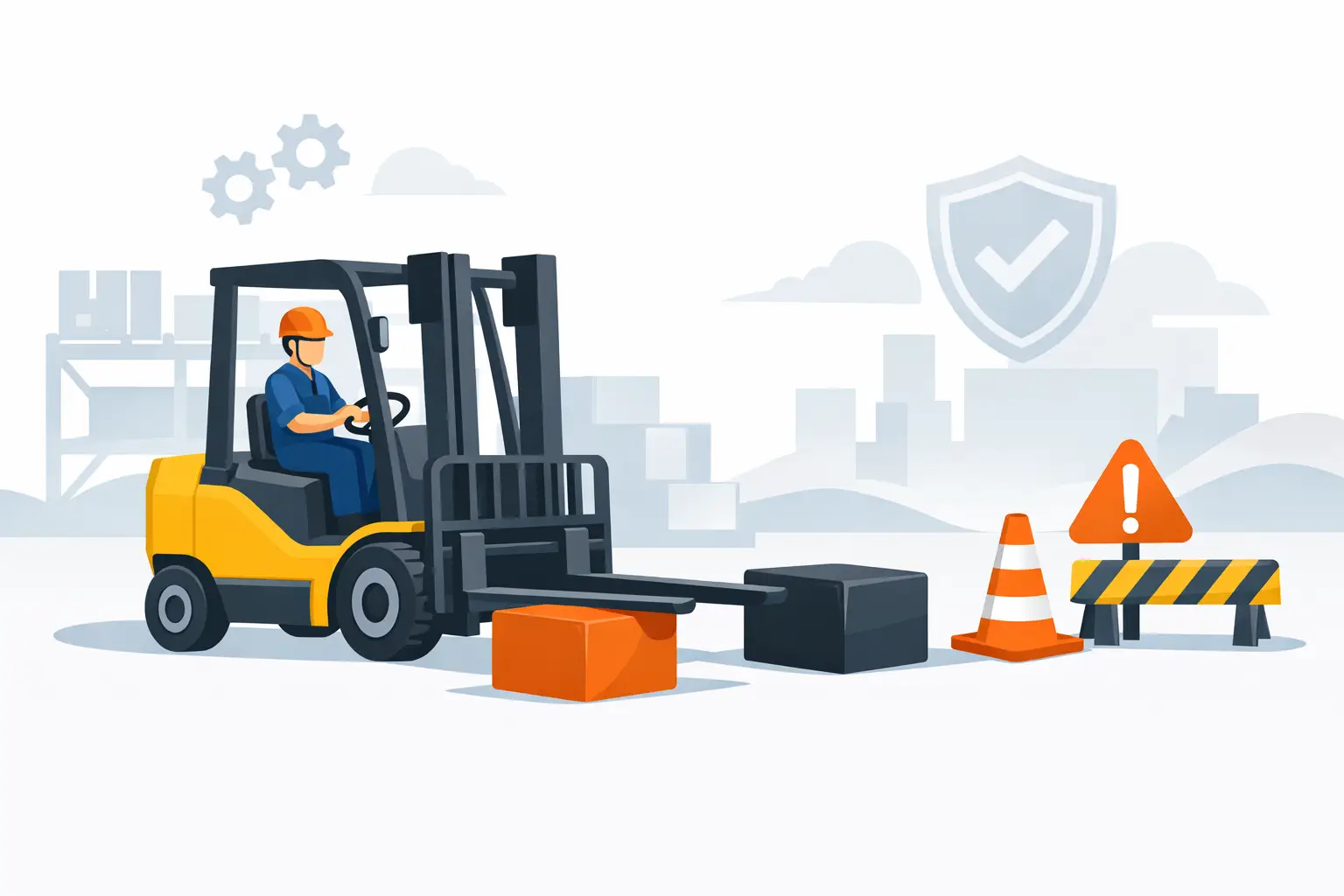
A forklift can be safely parked one minute and become a serious crush hazard the next when service work starts underneath it. Forklift safety blocks provide a physical support point during maintenance, helping technicians reduce risk when working around raised forks, masts, carriages, or other supported components. They are simple equipment, but selecting the correct block and using it correctly requires more than placing a piece of material under a load.
For workshop managers, fleet-service teams, and warehouse maintenance crews, the objective is clear: create a reliable, visible, repeatable safety procedure before anyone enters a pinch-point area. The right support block helps turn that procedure into daily practice without adding unnecessary weight, setup time, or risk of damage to the equipment.
Forklift safety blocks are purpose-built supports used to secure a raised forklift component during inspection, repair, or maintenance. Depending on the equipment and task, a block may support the mast, carriage, fork assembly, chassis, or another designated point identified by the forklift manufacturer.
Their role is not to lift the truck. Hydraulic systems, jacks, hoists, or lift equipment perform the lifting. The block is then positioned as a secondary mechanical support before work begins. This distinction matters. Hydraulics can leak down, controls can be activated accidentally, and a machine can shift when a load is removed or a component is disconnected. A correctly fitted safety block provides a physical barrier against unintended descent.
Material choice matters as well. Traditional steel supports can be heavy to carry, noisy to position, and more likely to mark painted surfaces or flooring. Industrial polyurethane blocks can offer a lighter handling option while maintaining high strength, impact resistance, and resistance to common workshop conditions. The correct material still depends on the load, support geometry, environment, and approved working procedure.
Maintenance teams are often under pressure to return a forklift to service quickly. That is when unsafe shortcuts appear: relying on hydraulic pressure alone, using timber offcuts, placing an unsuitable jack stand under an unstable point, or assuming a raised carriage will remain stationary for a short task.
Those shortcuts create uncertainty. Wood can split, crush, absorb fluids, or vary significantly in condition. Improvised steel pieces may slide, damage contact surfaces, or lack a predictable load rating. A support solution designed for forklift work is easier to identify, inspect, store, and use consistently.
A dedicated block also supports better communication. When a technician sees the approved block in position, the status of the work area is clear. This is particularly valuable in busy workshops where more than one person may be working around the truck, where operators move between shifts, or where outside service providers enter the facility.
There is no universal block that fits every forklift, mast configuration, or maintenance task. The correct choice starts with the service manual and the manufacturer-approved support locations. A block must match the available clearance and contact shape while providing stable support on both the forklift and the floor or lift surface.
The block must be rated for the application and used within its intended limits. Do not estimate capacity based on the total forklift nameplate capacity or truck weight alone. The force at a particular support point can differ substantially depending on the raised component, mast angle, attachment configuration, and where the load is transferred.
Look at the contact surfaces. A flat block may be appropriate for a flat, designated support area, while a shaped or slotted design may be necessary to prevent movement around a rail, carriage member, or other profile. The goal is full, stable contact - not a small edge bearing against a rounded or uneven surface.
Block height affects both safety and access. A block that is too low may not provide sufficient clearance for the required task. One that is too high may require excessive lifting, create an unstable setup, or place the mast and carriage outside a safe working position.
Measure the actual clearance available with the equipment raised at the approved service point. Also consider the technician's access to grease fittings, chains, rollers, hydraulic connections, and components behind guards. The safest setup is not necessarily the tallest one. It is the setup that supports the equipment securely while allowing the planned work to be completed without reaching into an unsupported area.
Polyurethane is a practical choice where teams need a durable, lower-weight block that resists repeated handling and helps protect surfaces. It can be especially useful in workshops where technicians regularly move supports between bays or work on finished equipment where surface damage is unacceptable.
However, no material removes the need for inspection. Oil, grease, ice, loose debris, damaged flooring, and poor positioning can compromise any support. If the work area is heavily contaminated or the floor is uneven, correct the conditions before relying on the block.
A disciplined sequence reduces guesswork. Start by parking the forklift on a level, solid surface away from active traffic. Lower the load, set the parking brake, place controls in neutral, and follow the site's shutdown and lockout procedure. Remove the key or isolate power where required by company policy and the service task.
Raise the relevant component using the approved lifting method. Keep hands, feet, and tools out of potential crush zones while positioning the forklift safety blocks. Place them only at approved support points, ensuring they sit squarely and cannot rock, slide, or bridge across gaps.
Then lower the component slowly onto the blocks until the support is carrying the intended load. Do not drop the equipment onto the block. Once seated, verify contact visually from a safe position. If the component is not level, the block is not fully engaged, or the truck shifts unexpectedly, raise it again and reset the arrangement.
Before a technician works beneath or within the supported area, perform a final check: the floor is stable, the block is undamaged, the contact points are correct, the energy isolation procedure is complete, and no one can operate the equipment. A second-person verification is a worthwhile control for higher-risk tasks or when less experienced technicians are involved.
A safety block should be inspected before use, not only during an annual equipment review. Check for cracks, deep cuts, crushed areas, deformation, embedded metal fragments, chemical attack, and worn contact surfaces. Any block that no longer sits flat or has questionable structural condition should be removed from service.
Storage is part of the system. Keep blocks in a marked location near the maintenance bay so technicians do not substitute scrap material when the correct support is out of reach. Avoid storing them where they can be driven over, exposed to unnecessary heat, or contaminated with debris. Clear identification also helps prevent a support block from being mistaken for a wheel chock, lift pad, or general-purpose spacer.
The most dangerous mistake is treating a safety block as a substitute for the forklift manufacturer's instructions. Support locations, mast arrangements, and service requirements vary by model. Always follow the OEM manual and facility safety procedures.
Other avoidable errors include using a block on a sloped floor, stacking blocks unless the design and procedure specifically allow it, placing blocks on loose pallets or cardboard, and working under a raised assembly before confirming that the support has taken the load. Never use a damaged block, and never allow a person to stand beneath a component supported only by hydraulic pressure.
Training should cover more than where the block is stored. Technicians need to understand why positioning, load transfer, surface condition, and isolation all matter. When the reason is clear, compliance becomes more consistent.
Forklift downtime is expensive, but an injury caused by an uncontrolled descent costs far more. Dedicated support equipment is a small part of a complete maintenance program that should also include operator reporting, scheduled inspections, approved lifting methods, lockout procedures, and trained technicians.
For operations that service multiple truck types, standardizing clearly identified blocks by application can reduce confusion and improve readiness. Rosén Innovation develops Swedish-made polyurethane safety products around lighter handling, high strength, and long-term industrial use - qualities that fit demanding workshop routines when the product is correctly specified for the task.
The best time to decide how a raised forklift will be supported is before the service bay is occupied. Make the approved block, the correct procedure, and the final verification part of every job, so safe support is never left to improvisation.