
Cart
Your cart is empty, but doesn't have to be..
Your cart is empty, but doesn't have to be..
Rosén Innovation COM |12/08, 2026
longer and wider chocks with more contact area. Widebody aircraft and heavy ground support equipment may require dedicated heavy-duty configurations rather than simply using more of a smaller product.
Do not select based on aircraft category alone. Two aircraft described as "mid-size jets" can have very different wheel and tire dimensions. Use the aircraft maintenance documentation, your ramp procedures, and the chock manufacturer's compatibility information to confirm fit before standardizing a product across the fleet.
A practical restraint choice accounts for the whole parking environment. Ask where aircraft are parked, who installs the chocks, how often they are moved, and what can compromise their position. The correct product is the one that delivers secure wheel contact while supporting fast, repeatable ground handling.
Four details should be confirmed during procurement:
A flat, enclosed maintenance hangar creates different demands than an exposed apron. On a clean, level concrete surface, fit and material performance may be the main concerns. On an outdoor ramp, crews also need a restraint that remains visible in low light, resists weathering, and can be positioned quickly while wearing gloves. If aircraft are regularly parked on a gradient, follow the aircraft operator's procedures for the number and placement of restraints. Product selection supports those procedures but does not replace them.
Main wheel restraints typically handle the primary parking load and are often the focus of chock selection. Nose wheel chocks can still be required by local procedures, aircraft manuals, or specific maintenance and towing conditions. Do not assume that one compact chock design fits both wheel positions.
A restraint designed around a larger main tire may not seat correctly against a smaller nose tire. Conversely, a small nose wheel chock should never be treated as a substitute for a properly sized main wheel restraint. Specify the wheel position and tire range when building your ramp inventory.
Traditional heavy rubber and metal chocks are familiar, but familiarity is not the same as operational efficiency. Every time a ramp agent carries, places, retrieves, and stores a restraint, its weight matters. Heavy equipment increases physical strain, slows turnaround work, and is more likely to be dropped onto pavement, equipment, or an aircraft surface.
Industrial polyurethane offers a useful balance for aircraft chocks: low weight, high strength, and resistance to repeated daily use. A well-engineered polyurethane chock can be easier to carry than a comparable heavy alternative while still maintaining the shape and tire contact needed for reliable restraint. It is also less likely to create the corrosion issues associated with metal products.
Material selection still depends on application. The polyurethane formulation, geometry, and intended load must work together. A lightweight chock is only an advantage when it remains stable under the conditions it is designed to handle. Check that the product is manufactured for aircraft use, not repurposed from a general vehicle application.
Recyclability is another purchasing consideration for organizations working to reduce material waste. Products designed from recyclable polyurethane can support a more practical end-of-life process than mixed-material equipment that is difficult to separate and dispose of. This benefit should come after fit, safety, and durability, not instead of them.
A restraint is useful only when crews can see it, confirm it is in place, and remove it at the correct time. Bright colors improve recognition on the ramp and help prevent a chock from being overlooked during walkarounds or departure preparation. Color choice may also be part of an operator's standardization program, helping teams quickly identify assigned equipment.
For night operations, poor weather, or high-traffic aprons, consider reflective markings or high-contrast color combinations. Visibility is especially relevant around white aircraft tires, gray concrete, and busy GSE lanes. However, markings must remain durable. A highly visible surface that quickly wears away does not provide long-term value.
Tethered pairs can improve control where procedures call for chocks to be installed and removed together. The connecting rope or strap should be durable, easy to grasp, and long enough to position each chock correctly without becoming a trip hazard. For operations with frequent towing, define where restraints are placed after removal so they do not end up under vehicles or in active traffic areas.
The contact between the restraint and the ground is just as relevant as the contact between the restraint and the tire. Smooth concrete, rough asphalt, painted ramps, and surfaces affected by fuel, hydraulic fluid, rain, snow, or sand can all change how a chock performs in service.
Choose a design with a stable base and sufficient footprint for the surface. A narrow base may be easier to store, but it can be less forgiving on uneven pavement. A broader restraint generally provides more stability, though it takes more storage space and may add weight. This is a real trade-off for mobile maintenance teams and compact service vehicles.
For outdoor use, assess resistance to UV exposure, temperature changes, moisture, and common ramp contaminants. The goal is not to find a product that eliminates the need for inspections. The goal is to select one that maintains its intended shape and function between inspections. Any restraint showing deep cuts, cracking, deformation, severe abrasion, or damaged tethering should be removed from service according to your safety process.
The best technical specification can fail if crews have to guess which restraint belongs with which aircraft. Standardize by aircraft class, tire range, or operating area, then label storage locations clearly. A consistent color, size, and marking system reduces decision time during busy turnarounds and makes missing equipment easier to spot.
Training should cover more than placement. Ramp personnel need to understand when wheel restraints are required, the correct sequence around parking and departure, how to inspect them, and when to report damage. Maintenance staff should also know that chocks are a parking restraint, not a substitute for approved aircraft jacking, towing, or brake procedures.
For larger fleets or multiple bases, purchasing in bulk can improve consistency and ensure replacement stock is available when equipment reaches the end of its service life. Keep a small buffer rather than waiting for a damaged chock to create a shortage during a shift.
The right jet restraint is not necessarily the largest or heaviest option. It is the correctly sized, clearly visible, durable product that crews can deploy reliably on your aircraft and ramp surface. Swedish-made polyurethane aircraft chocks from Rosén Innovation are designed around that practical requirement: lighter handling, dependable strength, and recyclable material for demanding daily operations.
Before placing an order, compare your actual tire sizes, parking conditions, and operational procedures against the product specification. A few minutes spent confirming compatibility gives ramp teams something more valuable than a generic chock: equipment they can trust every time an aircraft comes to a stop.
">
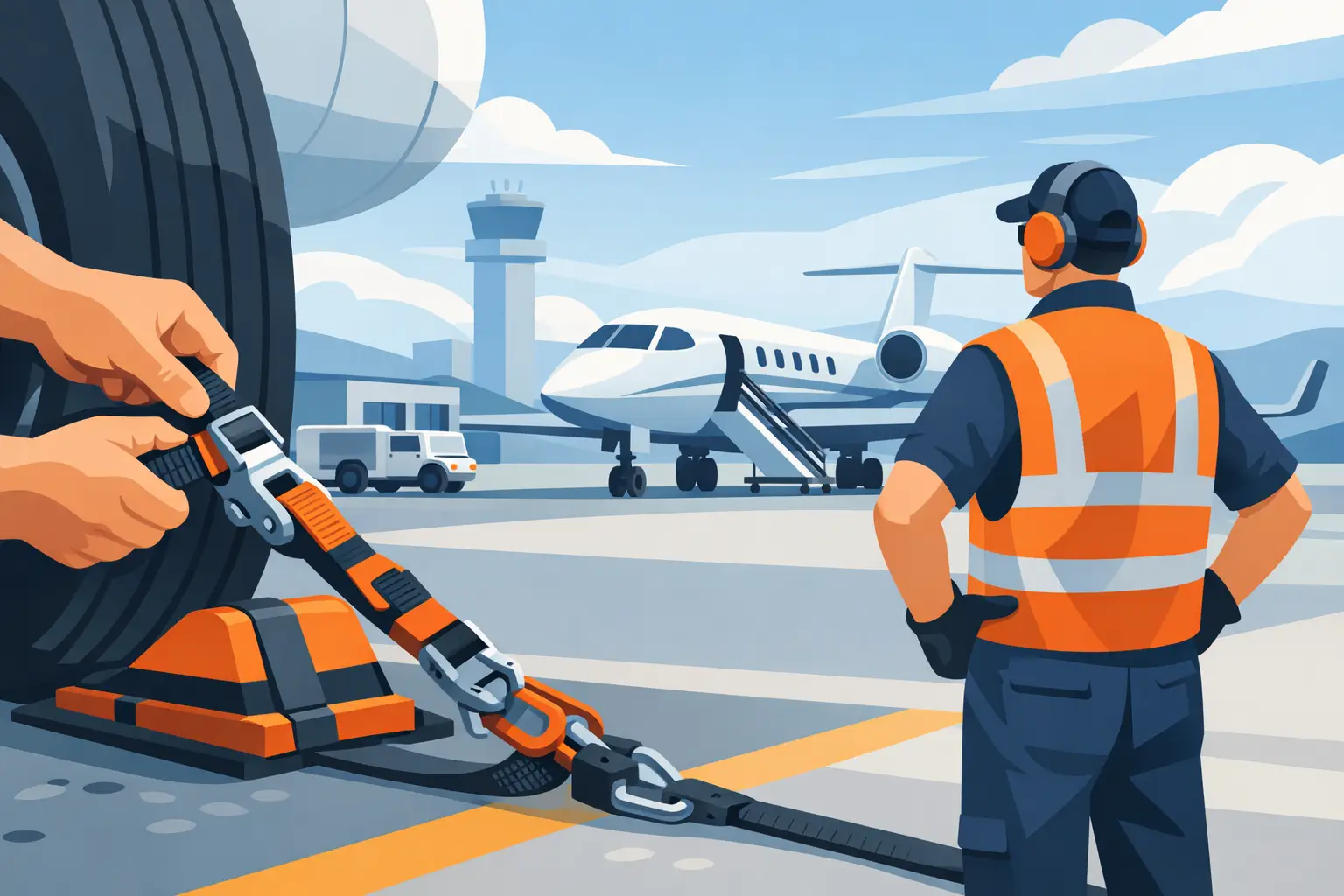
A jet can be parked at the correct stand, shut down, and connected to ground support equipment, yet still be exposed to unnecessary risk if the wheel restraint is undersized, misplaced, or difficult for the crew to handle. Wind, slope, brake status, towing activity, and repeated ramp traffic all affect the restraint requirement. Knowing how to choose jet restraints means matching the product to the aircraft, the operating surface, and the way your team actually works.
For most ramp operations, jet restraints are aircraft wheel chocks. Their job is simple: prevent unintended aircraft movement when parked or during servicing. The selection process is not simple if it relies on a one-size-fits-all approach. A chock that works well for a light business jet may not provide the contact area, profile, or handling characteristics required for a larger aircraft with significantly different tire dimensions and operating loads.
The aircraft type is the first filter, but it should not be the only specification used. Check the main and nose wheel tire diameter, tire width, wheel arrangement, and the aircraft's operating weight range. A restraint must sit firmly against the tire and provide a stable blocking angle without creating a point load that can damage the tire or allow the chock to shift.
For narrow tires on smaller jets, a compact chock with an appropriate tire-facing profile can provide dependable restraint without unnecessary bulk. Larger business jets, regional aircraft, and airliners generally need longer and wider chocks with more contact area. Widebody aircraft and heavy ground support equipment may require dedicated heavy-duty configurations rather than simply using more of a smaller product.
Do not select based on aircraft category alone. Two aircraft described as "mid-size jets" can have very different wheel and tire dimensions. Use the aircraft maintenance documentation, your ramp procedures, and the chock manufacturer's compatibility information to confirm fit before standardizing a product across the fleet.
A practical restraint choice accounts for the whole parking environment. Ask where aircraft are parked, who installs the chocks, how often they are moved, and what can compromise their position. The correct product is the one that delivers secure wheel contact while supporting fast, repeatable ground handling.
Four details should be confirmed during procurement:
A flat, enclosed maintenance hangar creates different demands than an exposed apron. On a clean, level concrete surface, fit and material performance may be the main concerns. On an outdoor ramp, crews also need a restraint that remains visible in low light, resists weathering, and can be positioned quickly while wearing gloves. If aircraft are regularly parked on a gradient, follow the aircraft operator's procedures for the number and placement of restraints. Product selection supports those procedures but does not replace them.
Main wheel restraints typically handle the primary parking load and are often the focus of chock selection. Nose wheel chocks can still be required by local procedures, aircraft manuals, or specific maintenance and towing conditions. Do not assume that one compact chock design fits both wheel positions.
A restraint designed around a larger main tire may not seat correctly against a smaller nose tire. Conversely, a small nose wheel chock should never be treated as a substitute for a properly sized main wheel restraint. Specify the wheel position and tire range when building your ramp inventory.
Traditional heavy rubber and metal chocks are familiar, but familiarity is not the same as operational efficiency. Every time a ramp agent carries, places, retrieves, and stores a restraint, its weight matters. Heavy equipment increases physical strain, slows turnaround work, and is more likely to be dropped onto pavement, equipment, or an aircraft surface.
Industrial polyurethane offers a useful balance for aircraft chocks: low weight, high strength, and resistance to repeated daily use. A well-engineered polyurethane chock can be easier to carry than a comparable heavy alternative while still maintaining the shape and tire contact needed for reliable restraint. It is also less likely to create the corrosion issues associated with metal products.
Material selection still depends on application. The polyurethane formulation, geometry, and intended load must work together. A lightweight chock is only an advantage when it remains stable under the conditions it is designed to handle. Check that the product is manufactured for aircraft use, not repurposed from a general vehicle application.
Recyclability is another purchasing consideration for organizations working to reduce material waste. Products designed from recyclable polyurethane can support a more practical end-of-life process than mixed-material equipment that is difficult to separate and dispose of. This benefit should come after fit, safety, and durability, not instead of them.
A restraint is useful only when crews can see it, confirm it is in place, and remove it at the correct time. Bright colors improve recognition on the ramp and help prevent a chock from being overlooked during walkarounds or departure preparation. Color choice may also be part of an operator's standardization program, helping teams quickly identify assigned equipment.
For night operations, poor weather, or high-traffic aprons, consider reflective markings or high-contrast color combinations. Visibility is especially relevant around white aircraft tires, gray concrete, and busy GSE lanes. However, markings must remain durable. A highly visible surface that quickly wears away does not provide long-term value.
Tethered pairs can improve control where procedures call for chocks to be installed and removed together. The connecting rope or strap should be durable, easy to grasp, and long enough to position each chock correctly without becoming a trip hazard. For operations with frequent towing, define where restraints are placed after removal so they do not end up under vehicles or in active traffic areas.
The contact between the restraint and the ground is just as relevant as the contact between the restraint and the tire. Smooth concrete, rough asphalt, painted ramps, and surfaces affected by fuel, hydraulic fluid, rain, snow, or sand can all change how a chock performs in service.
Choose a design with a stable base and sufficient footprint for the surface. A narrow base may be easier to store, but it can be less forgiving on uneven pavement. A broader restraint generally provides more stability, though it takes more storage space and may add weight. This is a real trade-off for mobile maintenance teams and compact service vehicles.
For outdoor use, assess resistance to UV exposure, temperature changes, moisture, and common ramp contaminants. The goal is not to find a product that eliminates the need for inspections. The goal is to select one that maintains its intended shape and function between inspections. Any restraint showing deep cuts, cracking, deformation, severe abrasion, or damaged tethering should be removed from service according to your safety process.
The best technical specification can fail if crews have to guess which restraint belongs with which aircraft. Standardize by aircraft class, tire range, or operating area, then label storage locations clearly. A consistent color, size, and marking system reduces decision time during busy turnarounds and makes missing equipment easier to spot.
Training should cover more than placement. Ramp personnel need to understand when wheel restraints are required, the correct sequence around parking and departure, how to inspect them, and when to report damage. Maintenance staff should also know that chocks are a parking restraint, not a substitute for approved aircraft jacking, towing, or brake procedures.
For larger fleets or multiple bases, purchasing in bulk can improve consistency and ensure replacement stock is available when equipment reaches the end of its service life. Keep a small buffer rather than waiting for a damaged chock to create a shortage during a shift.
The right jet restraint is not necessarily the largest or heaviest option. It is the correctly sized, clearly visible, durable product that crews can deploy reliably on your aircraft and ramp surface. Swedish-made polyurethane aircraft chocks from Rosén Innovation are designed around that practical requirement: lighter handling, dependable strength, and recyclable material for demanding daily operations.
Before placing an order, compare your actual tire sizes, parking conditions, and operational procedures against the product specification. A few minutes spent confirming compatibility gives ramp teams something more valuable than a generic chock: equipment they can trust every time an aircraft comes to a stop.