
Cart
Your cart is empty, but doesn't have to be..
Your cart is empty, but doesn't have to be..
Rosén Innovation COM |1/09, 2026
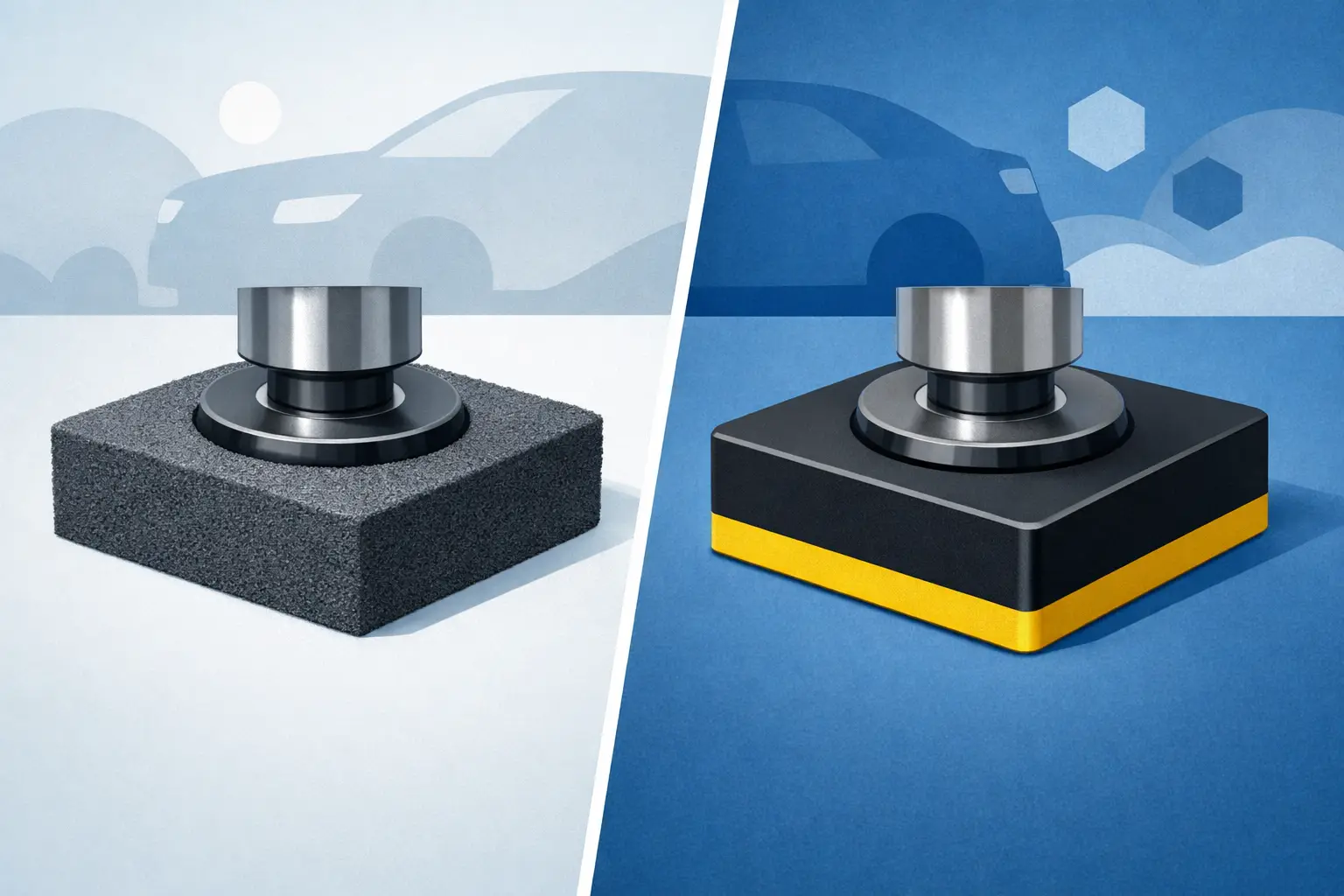
A flat pad may work well under a reinforced frame rail or a broad flat support point. A slotted pad is often needed for vehicles with pinch weld seams. Round pucks, rectangular blocks, and vehicle-specific adapters each solve different alignment problems. Using a flat pad on a sharp seam can concentrate force and cut into the material. Using a slot that is too narrow can pinch the seam or prevent the vehicle from sitting level.
Before ordering, verify the pad's outside dimensions, thickness, slot width and depth where applicable, and the diameter or shape of the lift contact surface. Also confirm whether the pad is intended for a two-post lift, scissor lift, floor jack, transmission jack, or a specific adapter system. A pad that fits the arm but not the vehicle is not a safe fit.
Never use a foam or polyurethane pad as a substitute for the manufacturer-approved lifting point, a required lift adapter, or correctly rated support equipment. Jack pads protect and position the contact area. They do not change the load rating of the lift, jack, or vehicle support stand.
Workshop floors are not clean laboratory surfaces. Pads encounter grit, metal filings, brake dust, road salt, lubricants, hydraulic fluid, cleaners, and frequent contact with painted or coated components. These conditions quickly expose the difference between a low-cost cushioning material and an engineered elastomer.
Foam can absorb fluid if it is open-cell, making it harder to clean and more likely to deteriorate. Even closed-cell foam can be vulnerable to cuts, edge damage, and breakdown from incompatible chemicals. Its light weight is useful, but low weight alone is not a performance advantage when the pad must handle repeated heavy loads.
Polyurethane resists abrasion well and can be manufactured in dense, durable forms that tolerate routine workshop handling. It is also less likely to crumble or shed when dragged across a gritty floor. For technicians, that means fewer interruptions to replace damaged pads and less uncertainty during setup.
Chemical resistance is not identical across all polyurethane formulations. If a shop regularly handles aggressive solvents, fuels, or specialized cleaners, check material compatibility rather than assuming any elastomer will perform the same way. The same applies to cold environments, where some materials become harder and less forgiving.
A common reason to choose foam is fear of marking painted, coated, or aluminum components. That concern is valid. Modern vehicles can have sensitive underbody panels, battery enclosures, composite structures, and finished lifting points that should not contact bare steel lift arms.
The answer is not necessarily the softest possible pad. A pad that collapses, shifts, or allows metal-to-metal contact can cause more damage than a firmer material with the right geometry. Polyurethane can provide a protective, non-marring interface while maintaining enough body to hold its shape under load.
The best option depends on contact pressure. A heavy EV, truck, or commercial vehicle may require a larger polyurethane contact area to avoid concentrated loading. A light passenger vehicle may need a narrow slotted pad that safely captures the pinch weld. In both cases, stable engagement is the priority.
Foam pads may cost less at the point of purchase. For occasional home use, light equipment, or non-load-bearing protective tasks, that can be reasonable. But purchase price is only one part of the decision for professional buyers.
A pad that deforms quickly needs more frequent replacement. It can slow technicians down, create inconsistent lift setups, and increase the chance of vehicle damage. One damaged rocker panel or crushed lifting point can outweigh the savings from choosing a lower-cost pad.
Polyurethane jack pads typically cost more because the material and manufacturing requirements are higher. Their value comes from longer usable life, repeatable support, lower replacement frequency, and dependable protection in high-use environments. For a workshop operating multiple bays or servicing a mixed fleet, those factors usually matter more than the initial unit price.
Start with the vehicle types your team lifts most often. Passenger cars, SUVs, EVs, vans, trucks, and specialty vehicles can require different pad profiles and contact areas. Then review the lifting equipment already in service, including arm-pad dimensions, adapter mounts, and rated load capacity.
Choose a pad with enough thickness to protect the vehicle while preserving stable lift geometry. Excessive thickness can reduce clearance or create an unstable stack. Too little thickness may allow hard metal contact or fail to accommodate a raised seam. The pad should sit flat, remain centered, and engage the vehicle lifting point without forcing the lift arm into an awkward angle.
For mixed fleets, maintaining several clearly identified pad types is often safer than trying to make one universal pad fit every vehicle. Keep flat pads, slotted pinch-weld pads, and larger-diameter pads organized by application. Inspect them during routine lift checks for deep cuts, cracking, permanent flattening, missing sections, contamination, and poor retention on the lift arm.
Rosén Innovation develops Swedish-made polyurethane workshop products around this practical requirement: lighter handling, high strength, reliable protection, and material performance suited to repeated industrial use.
The right jack pad should make the lifting process uneventful. When the profile fits, the material recovers, and the contact point stays stable, technicians can focus on the service work rather than questioning what is underneath the vehicle.
">
A jack pad is a small component with a direct effect on vehicle protection, lift stability, and technician safety. When comparing foam versus polyurethane jack pads, the material decision is not simply about softness. It determines how the pad behaves under repeated compression, whether it stays correctly positioned, and how long it can protect lifting points before replacement is needed.
For professional workshops, fleet-service teams, and maintenance departments, polyurethane is generally the stronger choice for daily lifting. Foam can have a place in light-duty protection or temporary applications, but it is rarely engineered for the concentrated forces, oils, abrasion, and repeated cycling found around vehicle lifts and floor jacks.
Foam is a broad material category. It can include open-cell or closed-cell products with very different densities, recovery rates, and resistance to fluids. Soft foam distributes light pressure well, which is why it is common in packaging, cushioning, and low-load surface protection. Under a lifting point, however, the same softness can become a limitation.
A vehicle jack pad carries force through a relatively small contact area. As the load rises, foam may compress heavily, spread sideways, permanently flatten, or tear at an edge. If the material loses its original shape, the pad may no longer center the lifting point properly. That creates uneven contact and increases the risk of damage to pinch welds, rocker panels, battery housings, or other protected structures.
Polyurethane elastomer is designed for a different working environment. It can combine controlled flexibility with high tear strength, abrasion resistance, and load-bearing capacity. A properly specified polyurethane pad compresses enough to conform to the vehicle's lifting point while retaining the structure needed to support and locate the load.
This balance matters most when lifts are used repeatedly throughout the day. A pad that rebounds consistently is easier to inspect, easier to position, and less likely to become an unreliable consumable after a short service interval.
Compression set describes how much a material fails to recover after it has been compressed. High compression set means the material stays flattened or deformed. For jack pads, that can mean a groove becomes too deep, a round pad loses its profile, or a slotted pad no longer supports a pinch weld evenly.
Foam often shows more permanent deformation when exposed to concentrated loads, particularly when heat, age, or petroleum products are involved. Polyurethane generally offers better recovery when matched to the intended load and geometry. That does not mean every polyurethane pad is suitable for every lift. Hardness, thickness, diameter, and contact shape still need to match the vehicle and lifting equipment.
The correct jack pad must fit both sides of the lift: the vehicle lifting point and the lift arm, saddle, or floor-jack cup. Material performance cannot compensate for an incorrect profile.
A flat pad may work well under a reinforced frame rail or a broad flat support point. A slotted pad is often needed for vehicles with pinch weld seams. Round pucks, rectangular blocks, and vehicle-specific adapters each solve different alignment problems. Using a flat pad on a sharp seam can concentrate force and cut into the material. Using a slot that is too narrow can pinch the seam or prevent the vehicle from sitting level.
Before ordering, verify the pad's outside dimensions, thickness, slot width and depth where applicable, and the diameter or shape of the lift contact surface. Also confirm whether the pad is intended for a two-post lift, scissor lift, floor jack, transmission jack, or a specific adapter system. A pad that fits the arm but not the vehicle is not a safe fit.
Never use a foam or polyurethane pad as a substitute for the manufacturer-approved lifting point, a required lift adapter, or correctly rated support equipment. Jack pads protect and position the contact area. They do not change the load rating of the lift, jack, or vehicle support stand.
Workshop floors are not clean laboratory surfaces. Pads encounter grit, metal filings, brake dust, road salt, lubricants, hydraulic fluid, cleaners, and frequent contact with painted or coated components. These conditions quickly expose the difference between a low-cost cushioning material and an engineered elastomer.
Foam can absorb fluid if it is open-cell, making it harder to clean and more likely to deteriorate. Even closed-cell foam can be vulnerable to cuts, edge damage, and breakdown from incompatible chemicals. Its light weight is useful, but low weight alone is not a performance advantage when the pad must handle repeated heavy loads.
Polyurethane resists abrasion well and can be manufactured in dense, durable forms that tolerate routine workshop handling. It is also less likely to crumble or shed when dragged across a gritty floor. For technicians, that means fewer interruptions to replace damaged pads and less uncertainty during setup.
Chemical resistance is not identical across all polyurethane formulations. If a shop regularly handles aggressive solvents, fuels, or specialized cleaners, check material compatibility rather than assuming any elastomer will perform the same way. The same applies to cold environments, where some materials become harder and less forgiving.
A common reason to choose foam is fear of marking painted, coated, or aluminum components. That concern is valid. Modern vehicles can have sensitive underbody panels, battery enclosures, composite structures, and finished lifting points that should not contact bare steel lift arms.
The answer is not necessarily the softest possible pad. A pad that collapses, shifts, or allows metal-to-metal contact can cause more damage than a firmer material with the right geometry. Polyurethane can provide a protective, non-marring interface while maintaining enough body to hold its shape under load.
The best option depends on contact pressure. A heavy EV, truck, or commercial vehicle may require a larger polyurethane contact area to avoid concentrated loading. A light passenger vehicle may need a narrow slotted pad that safely captures the pinch weld. In both cases, stable engagement is the priority.
Foam pads may cost less at the point of purchase. For occasional home use, light equipment, or non-load-bearing protective tasks, that can be reasonable. But purchase price is only one part of the decision for professional buyers.
A pad that deforms quickly needs more frequent replacement. It can slow technicians down, create inconsistent lift setups, and increase the chance of vehicle damage. One damaged rocker panel or crushed lifting point can outweigh the savings from choosing a lower-cost pad.
Polyurethane jack pads typically cost more because the material and manufacturing requirements are higher. Their value comes from longer usable life, repeatable support, lower replacement frequency, and dependable protection in high-use environments. For a workshop operating multiple bays or servicing a mixed fleet, those factors usually matter more than the initial unit price.
Start with the vehicle types your team lifts most often. Passenger cars, SUVs, EVs, vans, trucks, and specialty vehicles can require different pad profiles and contact areas. Then review the lifting equipment already in service, including arm-pad dimensions, adapter mounts, and rated load capacity.
Choose a pad with enough thickness to protect the vehicle while preserving stable lift geometry. Excessive thickness can reduce clearance or create an unstable stack. Too little thickness may allow hard metal contact or fail to accommodate a raised seam. The pad should sit flat, remain centered, and engage the vehicle lifting point without forcing the lift arm into an awkward angle.
For mixed fleets, maintaining several clearly identified pad types is often safer than trying to make one universal pad fit every vehicle. Keep flat pads, slotted pinch-weld pads, and larger-diameter pads organized by application. Inspect them during routine lift checks for deep cuts, cracking, permanent flattening, missing sections, contamination, and poor retention on the lift arm.
Rosén Innovation develops Swedish-made polyurethane workshop products around this practical requirement: lighter handling, high strength, reliable protection, and material performance suited to repeated industrial use.
The right jack pad should make the lifting process uneventful. When the profile fits, the material recovers, and the contact point stays stable, technicians can focus on the service work rather than questioning what is underneath the vehicle.