
Cart
Your cart is empty, but doesn't have to be..
Your cart is empty, but doesn't have to be..
Rosén Innovation COM |19/08, 2026
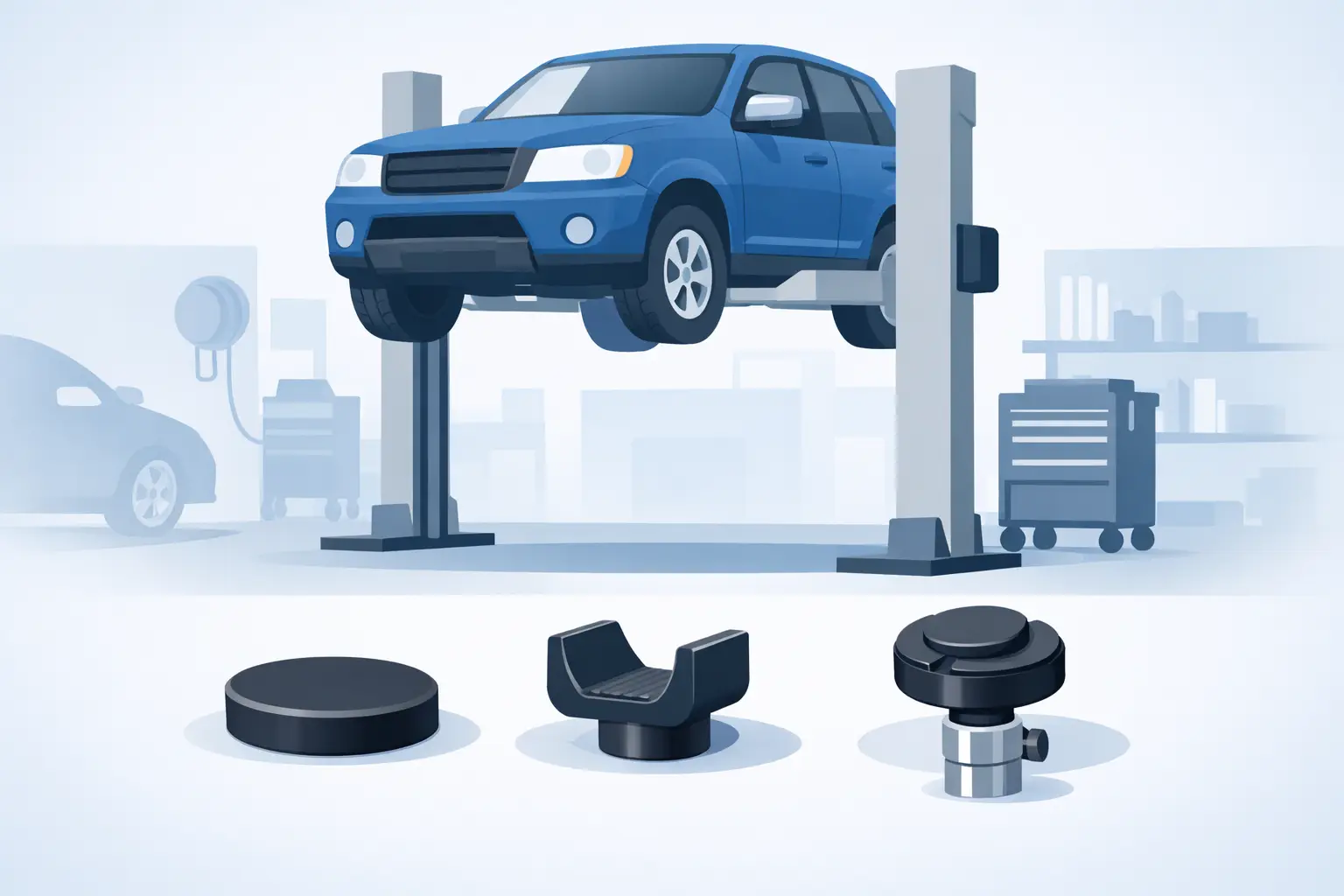
Industrial polyurethane offers a practical balance for many lift-pad applications. It is durable, resistant to oils and workshop contaminants, and less likely to damage painted or coated contact points than bare metal. Its controlled grip also helps reduce movement at the interface. Material alone does not make an adapter safe, however. The design, thickness, and support beneath the material must be suitable for the load.
For high-throughput workshops, evaluate adapters by their full operating environment: vehicle weight, lift capacity, number of daily cycles, exposure to oil and chemicals, temperature changes, and technician handling. A lightweight, durable polyurethane adapter can reduce handling strain and hold up well in demanding use, provided it is correctly sized and supported.
Never assume an adapter is rated for the full capacity printed on a vehicle lift. The practical limit is determined by the lowest-rated component in the setup: the lift, arms, receiver, adapter, and vehicle lifting-point specification.
Load distribution also changes the calculation. A vehicle's front end may carry substantially more weight than its rear, particularly with engines, batteries, or equipment installed. A pair of adapters at the front may see a much greater share of the load than a simple four-way split suggests. Off-center vehicles, uneven floors, and suspension movement during lifting add further variables.
Use adapters only within their stated application and capacity. If a product does not provide clear load guidance, dimensions, and intended use, it is not a strong choice for professional lifting operations. Inspect pads before use for cracking, compression damage, worn slots, loose stems, or deformation. Replace damaged components instead of trying to extend their service life with makeshift repairs.
A dry fit takes minutes and can prevent a costly incident. Position the lift arms under the approved points, install the adapters fully, and lower each pad until it just touches the vehicle. Confirm that every adapter is centered, stable, and contacting only the intended reinforced area.
Raise the vehicle a few inches, then stop. Check that the arms remain properly located, the pads have not shifted, and the vehicle is stable. Follow the lift manufacturer's operating procedure for secondary locks and stability checks before raising to working height. This step is especially important with low-profile vehicles, EVs, modified trucks, and vehicles with corroded or damaged underbodies.
The most efficient workshops do not solve adapter compatibility from scratch every time a vehicle arrives. They maintain a fit chart that connects common vehicle platforms to approved lifting points and the matching adapter type. The chart should also identify which lift bays use which receiver sizes.
This approach reduces technician guesswork, improves consistency between shifts, and makes purchasing easier. Rosén Innovation's polyurethane workshop components are designed around practical fit, durability, and protection in repeated industrial use, but every adapter should still be verified against the exact lift and vehicle application before it enters service.
The right jack adapter is the one that fully seats in the lift, supports the approved vehicle point, carries the load within its rating, and stays stable through the complete lift cycle. Measure first, test at low height, and treat fit as a safety specification rather than an accessory choice.
">
A vehicle can be perfectly positioned on a lift and still be at risk if the contact point is wrong. The question, which jack adapter fits, is not answered by vehicle make alone. You need to match the adapter to the lift, the vehicle's approved lifting points, and the type of service being performed. A close-looking fit is not good enough when the adapter carries the load between several thousand pounds of vehicle and the lifting equipment below it.
For workshops, fleet teams, and service centers, correct fit protects more than the vehicle. It helps prevent unstable lifting, crushed pinch welds, damaged battery trays, distorted rocker panels, and avoidable technician exposure. The right adapter should sit securely in the lift pad receiver and support the vehicle at its manufacturer-designated jacking point without slipping or concentrating load where it does not belong.
The vehicle owner's manual or service information identifies approved lifting points. These may be reinforced pinch welds, frame rails, subframe pads, round jack points, or dedicated lift blocks. Modern vehicles often use more than one design across a model range, especially where hybrid and EV battery protection changes the underbody layout.
Inspect the point before selecting an adapter. Look for its shape, width, height clearance, and condition. A slotted adapter can protect a pinch weld by allowing the seam to sit inside a channel rather than carrying the entire load on its narrow edge. A flat polyurethane pad may be appropriate for a broad, reinforced contact surface. Round or cupped adapters are commonly used where the vehicle has a matching circular lift point.
Do not choose an adapter simply because it fits under the vehicle. It must support the intended contact area. If there is uncertainty about the approved point, stop and confirm the vehicle data before lifting.
Once the vehicle contact point is known, measure the lift side of the connection. Jack adapters and lift pads are made to fit specific receiver diameters, pin sizes, mounting plates, and pad configurations. An adapter designed for a 2-inch receiver can be unsafe or unusable in a smaller or larger receiver, even if it appears to sit in place.
Measure the receiver opening with calipers where possible. Record the inside diameter, depth, and whether the pad uses a pin, threaded stem, drop-in post, or bolt-on connection. Also check for retention features. Some lift arms use a simple post, while others require a specific locking or locating arrangement to prevent the pad from lifting out of the arm during positioning.
The adapter height matters as well. A taller adapter may provide clearance around underbody shields or side skirts, but it reduces available lifting travel and can create a less favorable starting angle on low-clearance vehicles. A shorter pad improves clearance under the vehicle but may not reach recessed lifting points. Correct height is a functional requirement, not a cosmetic preference.
For repeatable purchasing, document the following dimensions for each lift bay and vehicle type:
This information turns a vague compatibility question into a clear specification. It also prevents buying adapters that fit one bay but cannot be used across the rest of the workshop.
Most incorrect adapter choices are shape mismatches. A universal flat pad has its place, but it cannot safely replace every specialized contact design.
A slotted pinch-weld pad is intended for vehicles with a defined seam along the rocker area. The slot reduces the chance of folding or crushing that seam. The slot must be wide enough for the weld and deep enough that the surrounding pad supports the reinforced area beside it. If the slot is too narrow, the pinch weld can bind. If it is too wide, the vehicle may not be adequately centered.
A flat pad suits broad, solid lifting surfaces. It is commonly used on frames, reinforced rails, and designated flat jack points. It should have enough surface area to distribute load without extending onto unsupported body panels or shields.
Round, puck-style adapters suit round lifting pads or recessed points. The diameter needs to match the supporting area, while the puck must sit fully in the recess without bottoming out on surrounding components. For vehicles with unusual underbody structures, a vehicle-specific adapter may be the right choice. Generic parts can save time at purchase but cost far more if they damage a lifting point.
Adapter material affects how the vehicle is supported. Steel adapters offer high structural strength but can mark coated surfaces or concentrate load unless paired with a protective contact layer. Hard plastic can be economical, but it may crack under repeated heavy loads, cold conditions, or off-center positioning.
Industrial polyurethane offers a practical balance for many lift-pad applications. It is durable, resistant to oils and workshop contaminants, and less likely to damage painted or coated contact points than bare metal. Its controlled grip also helps reduce movement at the interface. Material alone does not make an adapter safe, however. The design, thickness, and support beneath the material must be suitable for the load.
For high-throughput workshops, evaluate adapters by their full operating environment: vehicle weight, lift capacity, number of daily cycles, exposure to oil and chemicals, temperature changes, and technician handling. A lightweight, durable polyurethane adapter can reduce handling strain and hold up well in demanding use, provided it is correctly sized and supported.
Never assume an adapter is rated for the full capacity printed on a vehicle lift. The practical limit is determined by the lowest-rated component in the setup: the lift, arms, receiver, adapter, and vehicle lifting-point specification.
Load distribution also changes the calculation. A vehicle's front end may carry substantially more weight than its rear, particularly with engines, batteries, or equipment installed. A pair of adapters at the front may see a much greater share of the load than a simple four-way split suggests. Off-center vehicles, uneven floors, and suspension movement during lifting add further variables.
Use adapters only within their stated application and capacity. If a product does not provide clear load guidance, dimensions, and intended use, it is not a strong choice for professional lifting operations. Inspect pads before use for cracking, compression damage, worn slots, loose stems, or deformation. Replace damaged components instead of trying to extend their service life with makeshift repairs.
A dry fit takes minutes and can prevent a costly incident. Position the lift arms under the approved points, install the adapters fully, and lower each pad until it just touches the vehicle. Confirm that every adapter is centered, stable, and contacting only the intended reinforced area.
Raise the vehicle a few inches, then stop. Check that the arms remain properly located, the pads have not shifted, and the vehicle is stable. Follow the lift manufacturer's operating procedure for secondary locks and stability checks before raising to working height. This step is especially important with low-profile vehicles, EVs, modified trucks, and vehicles with corroded or damaged underbodies.
The most efficient workshops do not solve adapter compatibility from scratch every time a vehicle arrives. They maintain a fit chart that connects common vehicle platforms to approved lifting points and the matching adapter type. The chart should also identify which lift bays use which receiver sizes.
This approach reduces technician guesswork, improves consistency between shifts, and makes purchasing easier. Rosén Innovation's polyurethane workshop components are designed around practical fit, durability, and protection in repeated industrial use, but every adapter should still be verified against the exact lift and vehicle application before it enters service.
The right jack adapter is the one that fully seats in the lift, supports the approved vehicle point, carries the load within its rating, and stays stable through the complete lift cycle. Measure first, test at low height, and treat fit as a safety specification rather than an accessory choice.