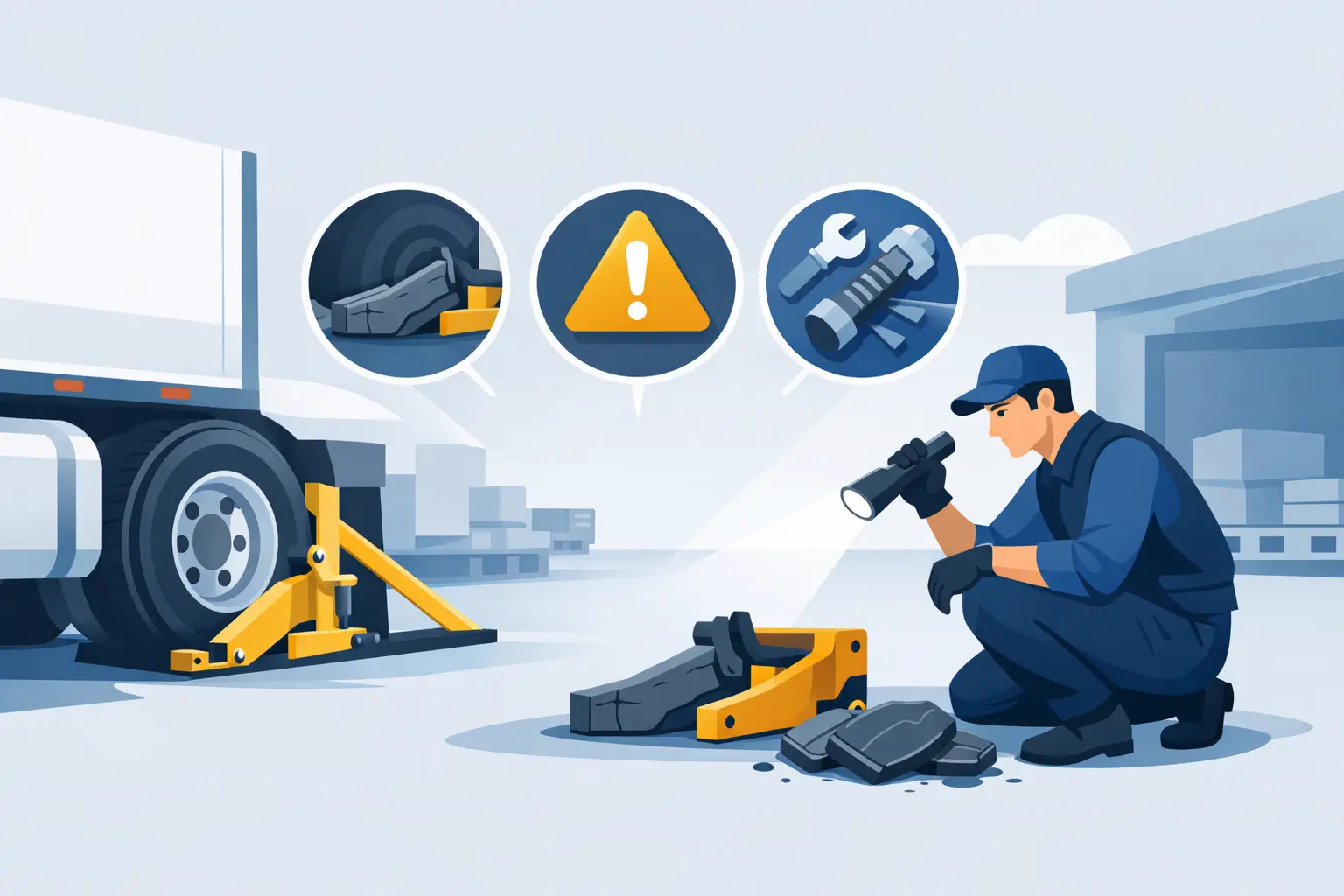
For aircraft, ground-support equipment, forklifts, trailers, and service vehicles, wheel restraints must match the tire, surface, operating conditions, and required procedure. They also need to survive repeated handling without becoming a source of foreign object debris, trip hazards, or unreliable wheel contact.
Do not judge condition by age alone
A calendar replacement interval can support preventive maintenance, but it should not be the only rule. A restraint used several times per day on an active ramp may need replacement sooner than one stored indoors and used occasionally. Heat, UV exposure, fuel and hydraulic-fluid contamination, wheel loads, rough pavement, towing activity, and improper storage all affect service life.
The correct question is not simply, “How old is this chock?” It is, “Can this restraint still provide stable, predictable contact with this wheel in this operating environment?” If the answer is uncertain, remove it from service until it can be inspected or replaced.
7 signs it is time to replace wheel restraints
1. Cracks, splits, or pieces missing
Visible cracking is a direct reason to inspect more closely. A shallow surface mark may be harmless, but a crack that opens under hand pressure, extends through the body, reaches a load-bearing edge, or develops around a rope hole can indicate a loss of structural integrity.
Replace the restraint when material is missing from the wheel-contact area, the base, or an edge that helps keep it stable. Loose fragments are also an FOD concern around aircraft and a housekeeping concern in workshops and warehouses.
2. The wheel-contact face is flattened or deformed
Wheel restraints work by creating a stable physical barrier at the tire. When the contact face has become noticeably flattened, compressed, curved incorrectly, or permanently distorted, it may no longer seat securely against the tire.
This is especially relevant where one chock is used across several tire diameters. A restraint that fits a small GSE tire may not provide adequate geometry for a larger aircraft, forklift, or trailer tire. Do not compensate for a poor fit by stacking restraints or placing damaged units in pairs. Select the correct size and profile instead.
3. The base no longer sits flat and stable
A restraint must make dependable contact with the ground as well as the wheel. Replace it if the base is warped, uneven, excessively worn, or rounded to the point that it rocks on a flat surface. Instability can become more serious on wet ramps, painted floors, uneven concrete, gravel, or sloped surfaces.
Check for embedded stones, hardened debris, and damage caused by dragging. Clean material may restore grip, but a base that remains distorted after cleaning should not stay in service.
4. Grip has been reduced by contamination or surface breakdown
Oil, fuel, hydraulic fluid, grease, de-icing chemicals, dirt, and loose gravel can reduce friction between the restraint and the ground. First, clean the unit according to the material supplier's instructions and inspect it again. If the surface remains slick, swollen, sticky, brittle, or visibly degraded, replacement is the safer choice.
Material selection matters here. Rubber, polyurethane, and composite products do not react identically to chemicals, weather, and repeated compression. A material suitable for indoor workshop use may not be the best choice for continuous outdoor ramp exposure. Match the product to the environment rather than expecting one restraint to cover every application.
5. A rope, handle, chain, or attachment point is damaged
A restraint may be structurally sound but unsafe to handle. Frayed ropes, loose handles, cracked eyelets, damaged chains, and stretched attachment points increase the chance of dropped equipment, awkward lifting, or a restraint being pulled into a wheel path.
Replace a damaged attachment component if it is integral to the product and cannot be replaced as an approved spare. Do not drill new holes, add improvised wire, or use a knot as a permanent repair. Changes to the restraint can weaken the body or create a snag hazard.
6. The restraint no longer matches the equipment or procedure
Operations change. A fleet may add larger aircraft, different GSE, new tire sizes, heavier service vehicles, or revised parking locations. A wheel restraint that was appropriate for the former setup can become undersized or incompatible without showing any physical damage.
Review fit whenever equipment specifications, loading conditions, or operating procedures change. Consider tire diameter and width, expected load, wheel configuration, surface grade, wind exposure where applicable, and whether the restraint is being used for parking, maintenance, or a controlled towing procedure. Follow aircraft, vehicle, and site-specific requirements where they are more restrictive.
7. Inspection history is unknown or staff no longer trust it
Unmarked, mixed, or poorly stored restraints are difficult to manage. If a unit has no identifiable size, material, inspection status, or known service history, it may be impossible to confirm that it is suitable for the job. This is common when chocks are shared between departments, left outdoors, or collected after temporary work.
When a ramp operator, technician, or driver questions a restraint's condition, treat that concern as useful information. Quarantine the item, inspect it, and replace it if suitability cannot be verified. The cost of a correctly matched restraint is small compared with the exposure created by unplanned movement.
A practical inspection routine for wheel restraints
A short pre-use inspection catches most failures before the restraint reaches the wheel. Check that the correct type and size are available, then look at the contact face, base, sides, and any handle or rope. Remove mud, ice, oil, stones, and debris. Place the restraint on a clean section of the intended surface and confirm that it sits flat without rocking.
For heavily used equipment, add a documented periodic inspection. The interval should reflect usage and conditions. Restraints used on a busy ramp, in a wash bay, or around chemical exposure need more frequent checks than units held in clean indoor storage. A simple identification mark or asset number makes it easier to track inspection status and remove questionable units from circulation.
Store restraints where they will not be run over, crushed by doors, exposed to unnecessary UV, or left in standing water. Storage discipline is not an administrative detail. It helps preserve material condition and ensures the correct equipment is available when an aircraft, vehicle, or GSE unit is parked.
Replacement is also a fit and handling decision
The replacement process is an opportunity to correct recurring operating problems. If crews report that restraints are difficult to carry, hard to position, too heavy for repeated use, or frequently lost, consider a lighter and more visible design with a suitable handle or retention option. If the same units are being used on different tire sizes, organize inventory by application rather than relying on whichever chock is closest.
For professional operations, keep a defined standard for each equipment class. Specify the restraint dimensions, material, quantity required, storage location, and inspection expectation. This makes purchasing more consistent and reduces the risk of using a marginal substitute during a busy shift.
Rosén Innovation designs Swedish-made polyurethane wheel chocks around low weight, durability, and dependable handling in demanding industrial and aviation environments. The right product still needs correct sizing, clean contact surfaces, and routine inspection to perform as intended.
A wheel restraint should inspire no debate at the point of use: it should fit the tire, sit firmly on the surface, and be ready for the load. If it does not, take it out of service and replace it before the next movement, not after an incident.