
Cart
Your cart is empty, but doesn't have to be..
Your cart is empty, but doesn't have to be..
Rosén Innovation COM |23/07, 2026
high tear resistance and a lighter handling weight than many dense rubber alternatives. Rubber can also be appropriate, particularly where its specific resistance properties suit the environment. The correct material depends on heat exposure, welding processes, contamination, cleaning methods, and expected service life.
No anti-fatigue mat should be treated as protection from direct molten-metal impact unless it is specifically rated for that exposure. Sparks and occasional hot particles are one thing. Continuous weld spatter, hot cutoffs, or direct placement near a severe heat source may require a dedicated heat-resistant layer, spark containment, or a different workstation layout.
Start with the operator's working zone. The mat should cover the position where the welder stands most often, including the natural movement area along the bench, fixture, or welding table. A mat that is too small forces the user to step on and off its edge throughout the shift. One that is unnecessarily large can interfere with access, material handling, or cleaning.
For a fixed workstation, measure the standing area rather than estimating from the table width. Consider where foot pedals, welding leads, gas lines, and tool carts are placed. The mat needs to support the worker without trapping or creating sharp bends in cables. In a multi-operator area, individual mats may be easier to replace and reposition than one large continuous surface.
Thickness should be chosen with the task in mind. More thickness does not automatically mean better ergonomics. A thick, soft mat may feel comfortable at first but can increase ankle movement and make precise work more tiring. For detailed fabrication, inspection, or repetitive bench work, a firm industrial mat with responsive cushioning is often the better choice. For long, mostly stationary shifts, a slightly more cushioned construction may be suitable if footing remains secure.
Edge design deserves a practical check before purchase. Low, tapered bevels make access safer and help reduce damage at the perimeter. This is particularly relevant in shops where pallet jacks, carts, welders, and mobile equipment move through the area. If traffic will regularly cross the mat, confirm that the product is intended for that use. Anti-fatigue mats are for standing workstations, not for carrying repeated vehicle or heavy rolling loads unless the manufacturer specifies otherwise.
Chemical exposure is another selection point. Welding bays often share space with solvents, cutting fluids, oils, degreasers, and cleaning products. A material that performs well in a dry fabrication area may not be the right choice beside a service bench with frequent oil contact. Procurement teams should document the likely contaminants and match them against the mat's material specifications before standardizing across a facility.
MIG and TIG stations generally present different floor conditions than heavy stick welding, plasma cutting, or grinding-intensive fabrication. A clean TIG area may prioritize operator comfort, cleanability, and static positioning. A heavy fabrication bay may require more attention to abrasion resistance, debris management, and the use of protective surfaces in locations exposed to hot particles.
For grinding stations beside welding tables, inspect the mat regularly for embedded metal fragments. A damaged or contaminated surface should not remain in service simply because it still looks usable from a distance. The same applies to mats with curled edges, tears, hard spots, or loss of grip. In industrial safety equipment, condition matters as much as original specification.
A mat performs best on a clean, dry, reasonably level floor. Before placement, remove loose scale, sharp fragments, and oil from the concrete. A mat installed over debris can rock, wear prematurely, and conceal hazards. If the floor is wet or contaminated, resolve the source first rather than using the mat to cover the problem.
Position the mat so its edges do not open into the most common walking route. Where possible, place the long dimension along the operator's movement path. Keep cables organized so they cross at controlled points instead of running beneath the mat or looping over an edge. A well-designed bay gives the worker room to move without turning the mat into another obstacle.
Cleaning should be simple enough to happen regularly. Sweep away metal dust and slag, then use a cleaning method compatible with the material. Avoid aggressive chemicals or tools that can damage the surface. A maintenance schedule is more effective than waiting until contamination is visible from several feet away. In high-use shops, a quick daily inspection and a more thorough weekly check are sensible controls.
Train operators to report movement, edge damage, or loss of surface traction. Mats are often overlooked because they are underfoot, but they affect every hour of a standing shift. Replacing a worn mat early costs less than managing a fall, a damaged floor, or recurring fatigue complaints.
Welding anti fatigue mats work best alongside correct bench height, suitable footwear, task rotation, and organized tool placement. A mat cannot compensate for a table that forces the welder to bend, twist, or reach beyond a safe working position. It can, however, reduce the accumulated stress of standing once the basic workstation geometry is right.
Footwear remains part of the equation. Safety boots with worn soles or poor fit can reduce the benefit of any ergonomic surface. Likewise, a mat that is effective for one operator may not produce the same result for another if work height, body position, or shift length differs. Ask operators where fatigue develops and observe the task during real production, not only during a brief workstation review.
For buyers managing multiple bays, standardization can simplify replacement, training, and stock control. It should not mean forcing one mat size or material into every environment. Group workstations by exposure and task type, then select a small number of proven configurations. This provides purchasing efficiency while keeping the specification tied to real operating conditions.
Rosén Innovation develops workplace products around the same practical requirements found in demanding industrial environments: durable materials, dependable support, and formats that fit the job. For welding areas, the goal is straightforward - give skilled operators a stable surface that supports long shifts without compromising safety or workflow.
A good mat should disappear into the routine of the shop. It stays flat, stays in place, cleans easily, and gives the operator a more comfortable place to work shift after shift. That is the standard worth specifying for any welding workstation.
">
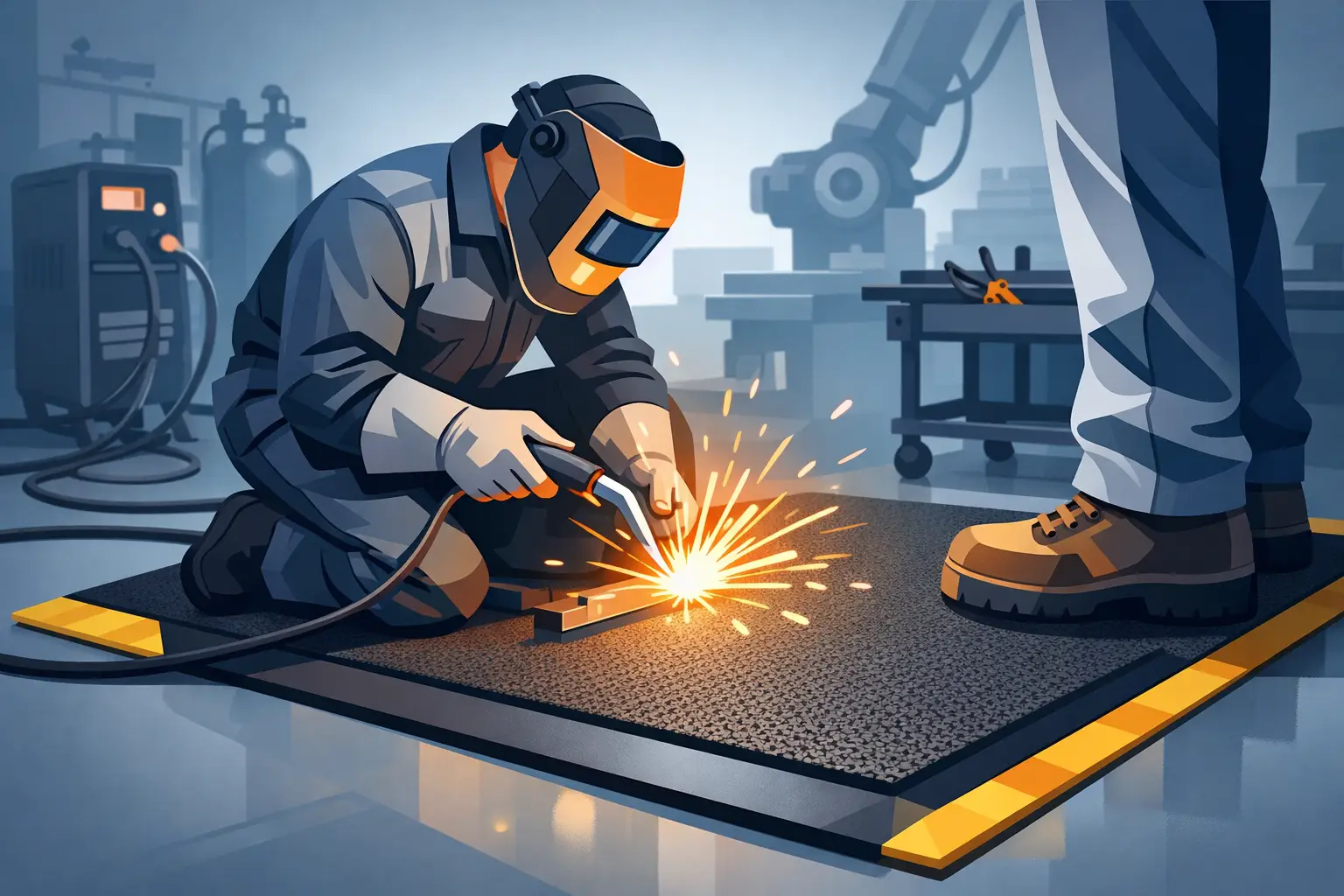
A welding booth can put more strain on an operator than the work itself suggests. The worker may stand in one position for long periods, shift between benches and fixtures, and work around cords, parts, slag, and equipment. Welding anti fatigue mats give that standing position a more supportive, stable surface while helping protect the floor beneath a high-use workstation.
The right mat is not a comfort accessory. In a production shop, maintenance bay, fabrication cell, or training facility, it is part of the workstation design. A poor choice can become a trip hazard, collect debris, deteriorate under heat, or move when the operator needs secure footing. A correctly specified mat reduces daily strain without creating new safety concerns.
Standard office or retail mats are not designed for welding areas. Welding introduces heat, abrasive debris, metal filings, oils, heavy footwear, rolling carts, and frequent cleaning. The mat must be selected for the actual exposure, not simply for its thickness or appearance.
Anti-fatigue performance comes from controlled resilience. A mat should provide enough give to reduce concentrated pressure on the feet, knees, and lower back, but not so much that it feels unstable. Operators need a firm, predictable platform for maintaining posture, controlling a torch, and moving safely around workpieces.
Surface grip matters just as much. Work boots can carry dust, moisture, grinding residue, and lubricant into the bay. A textured top surface helps maintain traction, while a stable underside helps prevent the mat from creeping across smooth concrete. Beveled edges are also important where personnel step on and off the mat repeatedly. They reduce the abrupt edge that can catch a boot toe or cart wheel.
Material selection determines whether the mat will hold up. Polyurethane is often a strong option for industrial anti-fatigue applications because it can combine long-term resilience with high tear resistance and a lighter handling weight than many dense rubber alternatives. Rubber can also be appropriate, particularly where its specific resistance properties suit the environment. The correct material depends on heat exposure, welding processes, contamination, cleaning methods, and expected service life.
No anti-fatigue mat should be treated as protection from direct molten-metal impact unless it is specifically rated for that exposure. Sparks and occasional hot particles are one thing. Continuous weld spatter, hot cutoffs, or direct placement near a severe heat source may require a dedicated heat-resistant layer, spark containment, or a different workstation layout.
Start with the operator's working zone. The mat should cover the position where the welder stands most often, including the natural movement area along the bench, fixture, or welding table. A mat that is too small forces the user to step on and off its edge throughout the shift. One that is unnecessarily large can interfere with access, material handling, or cleaning.
For a fixed workstation, measure the standing area rather than estimating from the table width. Consider where foot pedals, welding leads, gas lines, and tool carts are placed. The mat needs to support the worker without trapping or creating sharp bends in cables. In a multi-operator area, individual mats may be easier to replace and reposition than one large continuous surface.
Thickness should be chosen with the task in mind. More thickness does not automatically mean better ergonomics. A thick, soft mat may feel comfortable at first but can increase ankle movement and make precise work more tiring. For detailed fabrication, inspection, or repetitive bench work, a firm industrial mat with responsive cushioning is often the better choice. For long, mostly stationary shifts, a slightly more cushioned construction may be suitable if footing remains secure.
Edge design deserves a practical check before purchase. Low, tapered bevels make access safer and help reduce damage at the perimeter. This is particularly relevant in shops where pallet jacks, carts, welders, and mobile equipment move through the area. If traffic will regularly cross the mat, confirm that the product is intended for that use. Anti-fatigue mats are for standing workstations, not for carrying repeated vehicle or heavy rolling loads unless the manufacturer specifies otherwise.
Chemical exposure is another selection point. Welding bays often share space with solvents, cutting fluids, oils, degreasers, and cleaning products. A material that performs well in a dry fabrication area may not be the right choice beside a service bench with frequent oil contact. Procurement teams should document the likely contaminants and match them against the mat's material specifications before standardizing across a facility.
MIG and TIG stations generally present different floor conditions than heavy stick welding, plasma cutting, or grinding-intensive fabrication. A clean TIG area may prioritize operator comfort, cleanability, and static positioning. A heavy fabrication bay may require more attention to abrasion resistance, debris management, and the use of protective surfaces in locations exposed to hot particles.
For grinding stations beside welding tables, inspect the mat regularly for embedded metal fragments. A damaged or contaminated surface should not remain in service simply because it still looks usable from a distance. The same applies to mats with curled edges, tears, hard spots, or loss of grip. In industrial safety equipment, condition matters as much as original specification.
A mat performs best on a clean, dry, reasonably level floor. Before placement, remove loose scale, sharp fragments, and oil from the concrete. A mat installed over debris can rock, wear prematurely, and conceal hazards. If the floor is wet or contaminated, resolve the source first rather than using the mat to cover the problem.
Position the mat so its edges do not open into the most common walking route. Where possible, place the long dimension along the operator's movement path. Keep cables organized so they cross at controlled points instead of running beneath the mat or looping over an edge. A well-designed bay gives the worker room to move without turning the mat into another obstacle.
Cleaning should be simple enough to happen regularly. Sweep away metal dust and slag, then use a cleaning method compatible with the material. Avoid aggressive chemicals or tools that can damage the surface. A maintenance schedule is more effective than waiting until contamination is visible from several feet away. In high-use shops, a quick daily inspection and a more thorough weekly check are sensible controls.
Train operators to report movement, edge damage, or loss of surface traction. Mats are often overlooked because they are underfoot, but they affect every hour of a standing shift. Replacing a worn mat early costs less than managing a fall, a damaged floor, or recurring fatigue complaints.
Welding anti fatigue mats work best alongside correct bench height, suitable footwear, task rotation, and organized tool placement. A mat cannot compensate for a table that forces the welder to bend, twist, or reach beyond a safe working position. It can, however, reduce the accumulated stress of standing once the basic workstation geometry is right.
Footwear remains part of the equation. Safety boots with worn soles or poor fit can reduce the benefit of any ergonomic surface. Likewise, a mat that is effective for one operator may not produce the same result for another if work height, body position, or shift length differs. Ask operators where fatigue develops and observe the task during real production, not only during a brief workstation review.
For buyers managing multiple bays, standardization can simplify replacement, training, and stock control. It should not mean forcing one mat size or material into every environment. Group workstations by exposure and task type, then select a small number of proven configurations. This provides purchasing efficiency while keeping the specification tied to real operating conditions.
Rosén Innovation develops workplace products around the same practical requirements found in demanding industrial environments: durable materials, dependable support, and formats that fit the job. For welding areas, the goal is straightforward - give skilled operators a stable surface that supports long shifts without compromising safety or workflow.
A good mat should disappear into the routine of the shop. It stays flat, stays in place, cleans easily, and gives the operator a more comfortable place to work shift after shift. That is the standard worth specifying for any welding workstation.