
Cart
Your cart is empty, but doesn't have to be..
Your cart is empty, but doesn't have to be..
Rosén Innovation COM |24/08, 2026
controlled resilience. It conforms slightly under load, helping create secure contact with the tire and surface without the hard metal-to-rubber interface associated with steel.
A maintenance team does not move wheel chocks once a week. They move them around aircraft, tugs, lifts, trailers, and ground-support equipment throughout the day. Repeated lifting of heavy steel components adds unnecessary load to operators, particularly when conditions require fast turnaround work or long walking distances.
Lower-weight polyurethane chocks support better ergonomics without requiring a compromise in safety. They are easier to position accurately against the tire, easier to remove after release, and more practical for mobile service teams. This is particularly valuable for helicopter operations, business aviation, GSE fleets, and maintenance environments where personnel handle equipment manually rather than with dedicated ramp vehicles.
The comparison is not simply lightweight versus heavy-duty. A properly engineered polyurethane chock can be both. Material formulation, geometry, base width, and the intended wheel size determine real working performance.
Steel may remain appropriate in fixed industrial settings where chocks are seldom moved, surfaces are highly abrasive, or a site has established procedures built around welded steel equipment. Some operations also specify steel due to legacy purchasing standards or unique environmental requirements.
However, steel should not be selected solely because it is heavy. A heavy chock that is difficult to deploy correctly can create its own operational risk. The most effective chock is one that matches the wheel, grips the surface, and is consistently used according to procedure.
Aircraft, vehicles, and workshop floors are expensive assets. Steel can scratch coated surfaces, chip paint, and mark concrete or hangar flooring when dragged or dropped. Over time, exposed steel may also corrode, leaving rough edges that increase the chance of surface damage.
Polyurethane is non-marking and non-sparking in normal use. This makes it a practical choice around aircraft tires, painted wheels, polished concrete, epoxy floors, and finished equipment. Its material properties also reduce the sharp-contact concerns associated with bent, worn, or corroded metal chocks.
For aviation buyers, surface protection is not cosmetic. Damage prevention supports cleaner maintenance areas, reduces avoidable repairs, and helps protect the professional appearance of aircraft and ground-support fleets.
Wheel chocks operate where conditions are rarely ideal. Ramps can be wet, dusty, icy, hot, or contaminated by oil, hydraulic fluid, and other residues. The chock must remain in place while the tire is secured, and the operating team must inspect it before use.
Polyurethane generally offers strong friction characteristics on many common ramp and workshop surfaces. Its slight resilience can improve contact compared with a rigid metal edge, particularly when the tire or ground is not perfectly uniform. Quality polyurethane also resists moisture and does not rust, which helps preserve its functional condition during outdoor storage and frequent washdown.
Steel can become slippery when wet or when its surface is worn smooth. Corrosion can further affect fit and handling. That does not mean every polyurethane chock will outperform every steel model in every condition. Tread pattern, chock angle, base design, and material quality must be considered as a complete system.
Steel is often viewed as the default durable choice because it is hard. Yet hardness is not the only measure that matters. A steel chock can bend after an impact, develop corrosion, or create sharp edges. Once its shape changes, its tire contact and stability may change as well.
High-quality polyurethane is designed to absorb impacts rather than permanently deform under ordinary handling. It resists cracking, chipping, water absorption, and many common industrial contaminants. It also performs well across a broad temperature range when the formulation is engineered for outdoor and aviation use.
The trade-off is that polyurethane must be specified correctly. Low-grade plastic products can become brittle in cold conditions, soften excessively in heat, or wear quickly on abrasive surfaces. Buyers should distinguish engineered polyurethane from generic molded plastic. Ask for the intended application, wheel capacity range, dimensions, and operating conditions rather than comparing material names alone.
A chock must fit the equipment it secures. A compact helicopter chock is not a substitute for a chock designed for an airliner wheel. Likewise, a large aircraft chock may be unnecessarily bulky for a small tug or service cart.
Start with the tire diameter and the aircraft or vehicle's operating weight. Then consider the parking surface, whether the equipment is parked indoors or outdoors, local weather, and whether the chock must be carried on board or stored in a GSE compartment. For paired chocks, check that the rope or connection method supports quick placement without creating a trip or FOD concern.
For operations managing several aircraft types, standardizing a range of correctly sized polyurethane chocks can simplify training, inventory, and visual identification. Color-coded or clearly marked configurations can also help teams place the right product with the right equipment.
No wheel chock can compensate for poor parking practice. Chocks should be placed against the tire in accordance with the aircraft, vehicle, and site procedure, normally on both sides of the wheel where required. Operators should inspect for cuts, deformation, contamination, excessive wear, and loose or damaged ropes before deployment.
They should also avoid using chocks as improvised blocks, jacking aids, or towing accessories unless the product is specifically designed for that purpose. A wheel chock, lift pad, forklift safety block, and jack support may all be made from polyurethane, but they serve different load paths and safety functions.
For professional buyers, polyurethane chocks deliver a clear operational advantage when the priority is lighter handling, dependable grip, aircraft-safe contact, and long service life without corrosion. Rosén Innovation develops and manufactures Swedish-made polyurethane solutions for demanding aviation and industrial environments, with configurations suited to aircraft, helicopters, and ground-support equipment.
Before replacing a fleet of steel chocks, measure the wheels, review your parking procedures, and assess what your operators carry on every shift. The best material is the one that gives your team a secure hold, correct fit, and fewer reasons to take shortcuts when the ramp is busy.
">
A wheel chock is only small until a ramp agent has to carry it repeatedly across an apron, place it under a loaded aircraft tire, and retrieve it in rain, fuel residue, heat, or snow. The choice between polyurethane versus steel wheel chocks affects more than purchase price. It affects handling speed, injury exposure, aircraft protection, and whether the chock remains dependable through daily service.
Steel has a long history in heavy industrial applications. Polyurethane has become a preferred material where high holding performance must be combined with lower weight, non-marking contact, weather resistance, and easier manual handling. Neither material is automatically correct for every operation. The right choice depends on the aircraft or vehicle, wheel diameter, operating surface, parking conditions, and the chock design itself.
The most immediate difference is weight. A steel chock can be difficult to lift, carry, and position, especially in larger sizes or when operators need multiple sets during a shift. That weight may feel reassuring, but mass alone does not determine a chock's ability to restrain a wheel. Shape, tire contact area, material friction, ground condition, and correct sizing all matter.
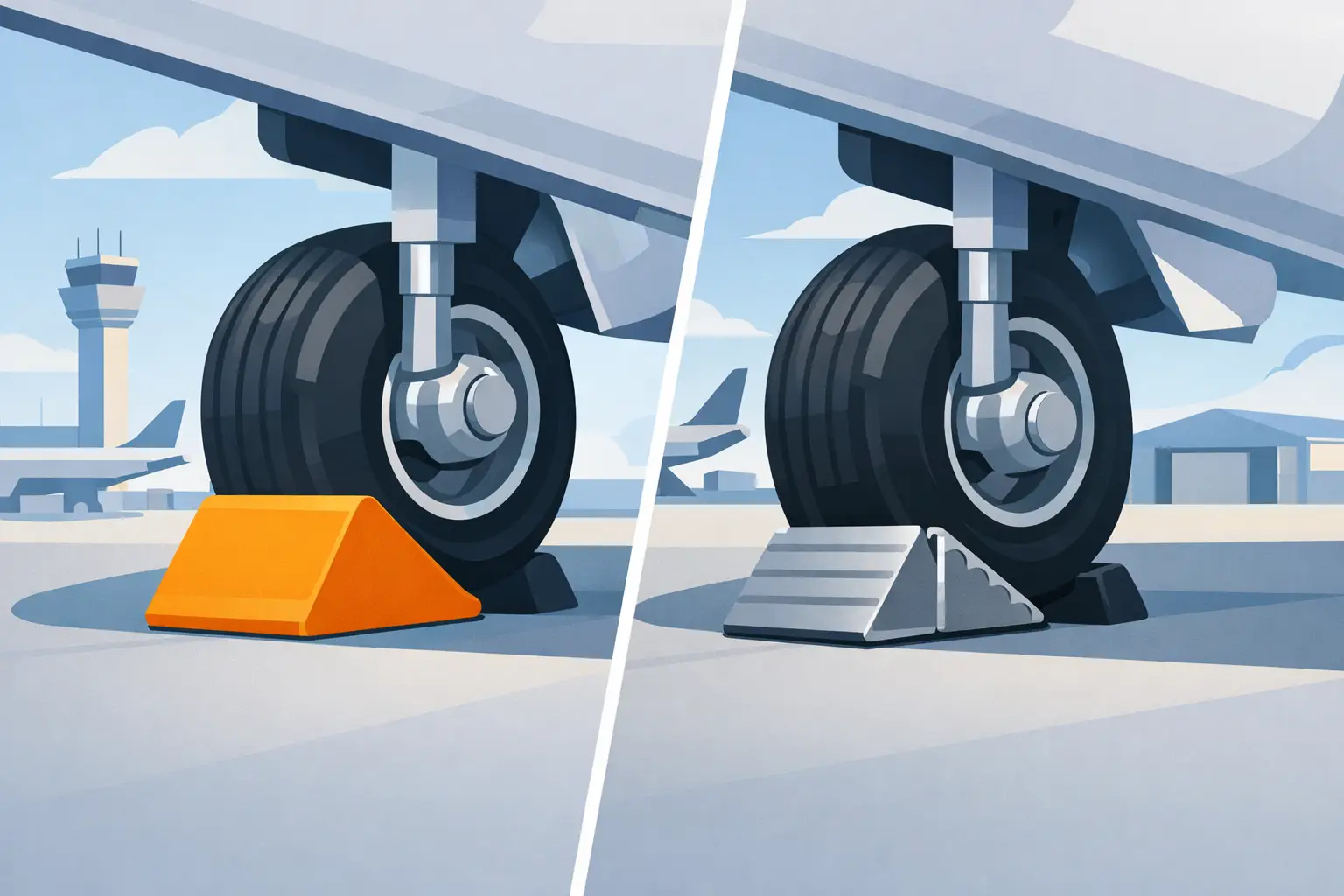
Polyurethane wheel chocks are significantly lighter than comparable steel products while maintaining high mechanical strength. For aircraft operations, that lower weight reduces physical strain during repetitive handling and makes stowage easier in service vehicles, hangars, and remote parking locations. It also reduces the risk of damage if a chock is dropped against an aircraft, wheel assembly, or sensitive ground-support equipment.
Steel chocks are rigid and can withstand hard impacts, but they have limited give at the contact point. Polyurethane has controlled resilience. It conforms slightly under load, helping create secure contact with the tire and surface without the hard metal-to-rubber interface associated with steel.
A maintenance team does not move wheel chocks once a week. They move them around aircraft, tugs, lifts, trailers, and ground-support equipment throughout the day. Repeated lifting of heavy steel components adds unnecessary load to operators, particularly when conditions require fast turnaround work or long walking distances.
Lower-weight polyurethane chocks support better ergonomics without requiring a compromise in safety. They are easier to position accurately against the tire, easier to remove after release, and more practical for mobile service teams. This is particularly valuable for helicopter operations, business aviation, GSE fleets, and maintenance environments where personnel handle equipment manually rather than with dedicated ramp vehicles.
The comparison is not simply lightweight versus heavy-duty. A properly engineered polyurethane chock can be both. Material formulation, geometry, base width, and the intended wheel size determine real working performance.
Steel may remain appropriate in fixed industrial settings where chocks are seldom moved, surfaces are highly abrasive, or a site has established procedures built around welded steel equipment. Some operations also specify steel due to legacy purchasing standards or unique environmental requirements.
However, steel should not be selected solely because it is heavy. A heavy chock that is difficult to deploy correctly can create its own operational risk. The most effective chock is one that matches the wheel, grips the surface, and is consistently used according to procedure.
Aircraft, vehicles, and workshop floors are expensive assets. Steel can scratch coated surfaces, chip paint, and mark concrete or hangar flooring when dragged or dropped. Over time, exposed steel may also corrode, leaving rough edges that increase the chance of surface damage.
Polyurethane is non-marking and non-sparking in normal use. This makes it a practical choice around aircraft tires, painted wheels, polished concrete, epoxy floors, and finished equipment. Its material properties also reduce the sharp-contact concerns associated with bent, worn, or corroded metal chocks.
For aviation buyers, surface protection is not cosmetic. Damage prevention supports cleaner maintenance areas, reduces avoidable repairs, and helps protect the professional appearance of aircraft and ground-support fleets.
Wheel chocks operate where conditions are rarely ideal. Ramps can be wet, dusty, icy, hot, or contaminated by oil, hydraulic fluid, and other residues. The chock must remain in place while the tire is secured, and the operating team must inspect it before use.
Polyurethane generally offers strong friction characteristics on many common ramp and workshop surfaces. Its slight resilience can improve contact compared with a rigid metal edge, particularly when the tire or ground is not perfectly uniform. Quality polyurethane also resists moisture and does not rust, which helps preserve its functional condition during outdoor storage and frequent washdown.
Steel can become slippery when wet or when its surface is worn smooth. Corrosion can further affect fit and handling. That does not mean every polyurethane chock will outperform every steel model in every condition. Tread pattern, chock angle, base design, and material quality must be considered as a complete system.
Steel is often viewed as the default durable choice because it is hard. Yet hardness is not the only measure that matters. A steel chock can bend after an impact, develop corrosion, or create sharp edges. Once its shape changes, its tire contact and stability may change as well.
High-quality polyurethane is designed to absorb impacts rather than permanently deform under ordinary handling. It resists cracking, chipping, water absorption, and many common industrial contaminants. It also performs well across a broad temperature range when the formulation is engineered for outdoor and aviation use.
The trade-off is that polyurethane must be specified correctly. Low-grade plastic products can become brittle in cold conditions, soften excessively in heat, or wear quickly on abrasive surfaces. Buyers should distinguish engineered polyurethane from generic molded plastic. Ask for the intended application, wheel capacity range, dimensions, and operating conditions rather than comparing material names alone.
A chock must fit the equipment it secures. A compact helicopter chock is not a substitute for a chock designed for an airliner wheel. Likewise, a large aircraft chock may be unnecessarily bulky for a small tug or service cart.
Start with the tire diameter and the aircraft or vehicle's operating weight. Then consider the parking surface, whether the equipment is parked indoors or outdoors, local weather, and whether the chock must be carried on board or stored in a GSE compartment. For paired chocks, check that the rope or connection method supports quick placement without creating a trip or FOD concern.
For operations managing several aircraft types, standardizing a range of correctly sized polyurethane chocks can simplify training, inventory, and visual identification. Color-coded or clearly marked configurations can also help teams place the right product with the right equipment.
No wheel chock can compensate for poor parking practice. Chocks should be placed against the tire in accordance with the aircraft, vehicle, and site procedure, normally on both sides of the wheel where required. Operators should inspect for cuts, deformation, contamination, excessive wear, and loose or damaged ropes before deployment.
They should also avoid using chocks as improvised blocks, jacking aids, or towing accessories unless the product is specifically designed for that purpose. A wheel chock, lift pad, forklift safety block, and jack support may all be made from polyurethane, but they serve different load paths and safety functions.
For professional buyers, polyurethane chocks deliver a clear operational advantage when the priority is lighter handling, dependable grip, aircraft-safe contact, and long service life without corrosion. Rosén Innovation develops and manufactures Swedish-made polyurethane solutions for demanding aviation and industrial environments, with configurations suited to aircraft, helicopters, and ground-support equipment.
Before replacing a fleet of steel chocks, measure the wheels, review your parking procedures, and assess what your operators carry on every shift. The best material is the one that gives your team a secure hold, correct fit, and fewer reasons to take shortcuts when the ramp is busy.