
Cart
Your cart is empty, but doesn't have to be..
Your cart is empty, but doesn't have to be..
Rosén Innovation COM |31/07, 2026
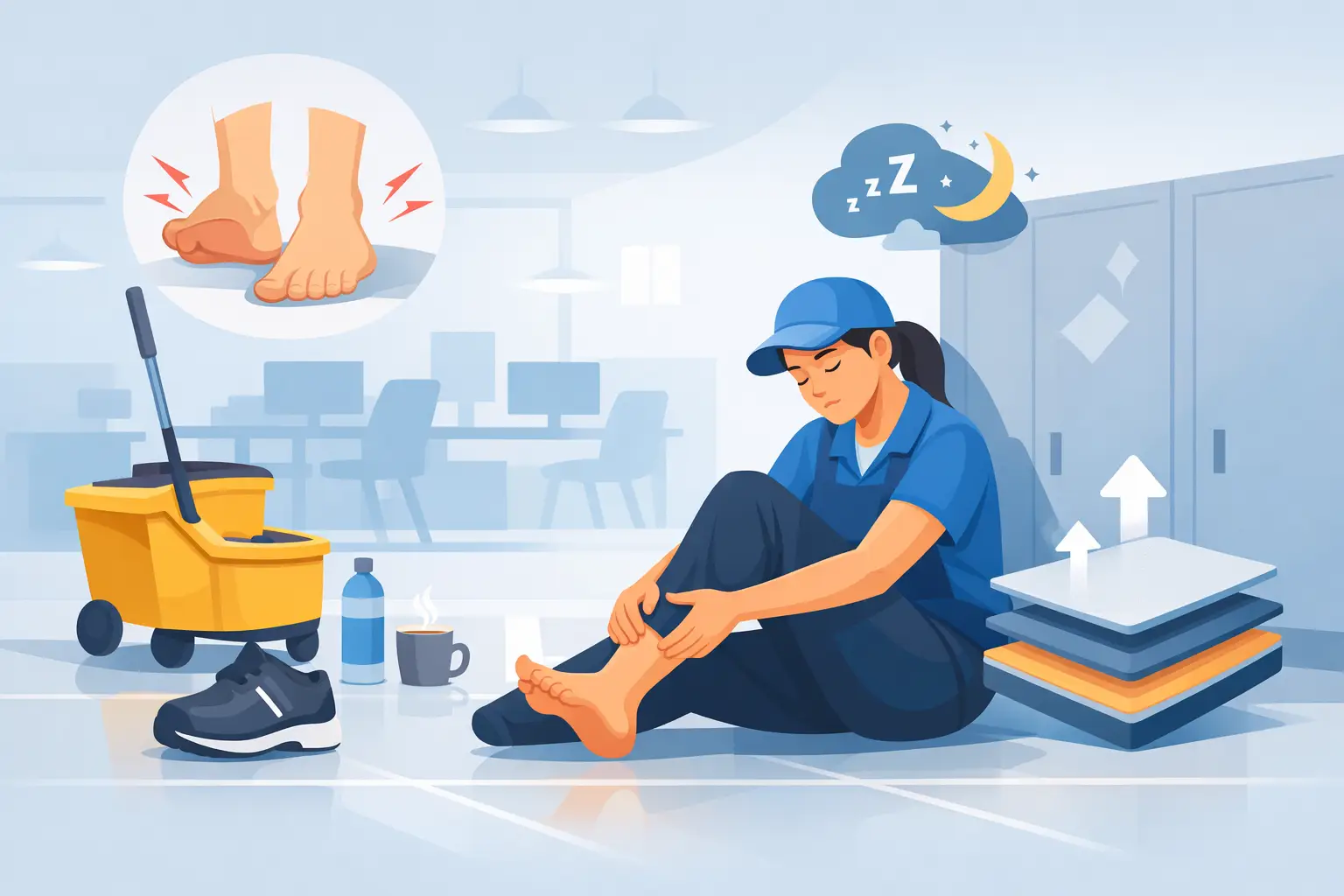
anti-fatigue mats create a resilient layer between the worker and the hard floor. A properly selected polyurethane or rubber mat helps distribute pressure underfoot and encourages small postural movements that reduce static muscle loading.
Material selection matters. A mat that is too soft may feel comfortable at first but can become unstable, especially where workers turn, carry loads, or use wheeled equipment nearby. A mat that is too thin may offer limited benefit over concrete. Industrial environments generally need a durable, supportive mat that stays flat, resists compression, and handles oils, moisture, and repeated foot traffic according to the conditions of the area.
For facilities that need long service life and reliable performance, polyurethane anti-fatigue mats offer a strong balance of resilience, low weight, and durability. Rosén Innovation develops Swedish-made polyurethane solutions for demanding workplaces where comfort must work alongside operational safety.
A mat only helps when the worker can stand on it throughout the task. Measure the natural reach zone at the station rather than choosing a size based only on available floor space. If the worker routinely steps sideways to retrieve parts, operate controls, or access tools, the mat should cover those movement areas where practical.
Avoid creating a narrow strip that forces employees to stand with one foot on the mat and one foot on bare concrete. That uneven position can create a different kind of strain. At wider stations, multiple mats may be more effective than one oversized mat, particularly when equipment access or cleaning procedures require defined sections.
Edges are equally important. Beveled edges reduce trip risk and make it easier for carts and foot traffic to pass around the workstation. Keep mats flat, clean, and properly positioned. A curled edge or a mat that slides during use becomes a safety hazard, not an ergonomic improvement.
Anti-fatigue mats reduce standing stress, but they do not replace movement. Static standing is demanding because the body stays in one position for too long. Small changes in posture, short walks, and alternating tasks support circulation and reduce localized muscle fatigue.
A practical work design may rotate employees between standing, walking, seated inspection, and material-handling tasks. The right rotation depends on the operation. In a high-volume packing area, frequent changes may disrupt output. In a maintenance shop, alternating diagnostic work with parts retrieval or documentation can provide natural variation without slowing the job.
Supervisors should also look at task layout. Frequently used tools, labels, parts, and controls should be within a comfortable reach range. Repeated twisting, bending, or reaching across a bench adds fatigue even when floor support is in place. Adjusting bench height, tool placement, and material presentation often produces meaningful improvement at low cost.
Short recovery breaks matter most when they are used to change position. Sitting briefly, walking to get water, stretching the calves, or shifting to a different task can be more useful than remaining at the same workstation while checking a phone. The goal is not a complicated wellness program. It is practical recovery that fits the workday.
Work boots and safety shoes are an essential part of fatigue control, but they cannot compensate for every poor floor condition. Footwear should provide stable support, appropriate toe protection, slip resistance, and cushioning suited to the task. A worker moving around a warehouse has different needs than a technician standing at a lift for long periods.
Fit is critical. Boots that are too loose allow the foot to slide, while boots that are too tight create pressure points and numbness. Insoles can help some workers, particularly when they provide arch support and are replaced before they flatten out. However, adding more cushioning is not always the answer. Very soft insoles can reduce stability for workers who climb, carry loads, or operate pedals.
Facilities should avoid treating footwear as the sole solution. If several employees report discomfort at the same fixed station, the issue is likely related to the work area, task duration, or floor surface as well as the shoes being worn.
Shift fatigue rises quickly when standing is combined with forceful work. A worker who stands on concrete while lifting heavy parts, using hand tools overhead, or pushing loaded carts faces a much higher physical demand than someone standing at a light-duty inspection point.
Review whether equipment can reduce force requirements. Lift tables, height-adjustable carts, properly matched vehicle-lift pads, tool balancers, and organized storage can reduce unnecessary bending and handling. In aviation and ground-support operations, lighter equipment also reduces the cumulative strain of repeated deployment. A lightweight wheel chock, for example, can be easier to carry and position than a heavier alternative while still providing dependable restraint when correctly specified.
Environmental conditions should not be ignored. Heat, cold, noise, poor lighting, and dehydration all make physical work feel harder and can speed up fatigue. These factors may not be solved by a mat or a new pair of boots, but they affect whether an ergonomic improvement delivers its full benefit.
Anti-fatigue mats should be included in normal facility inspections. Check for worn surfaces, cracking, compression, curled corners, contamination, and movement across the floor. Replace mats that no longer sit flat or provide stable support.
Cleaning procedures need to fit the material and the environment. Oil, metal chips, chemical residue, and moisture can reduce traction if they are allowed to build up. In wet or oily areas, select a mat designed for those conditions rather than placing a general-purpose comfort mat where it cannot perform safely.
It is also worth asking employees where discomfort appears during the shift. Their feedback can reveal that a station needs a different mat size, a layout change, or more task rotation. Reports of foot, knee, hip, or back discomfort should be taken seriously, especially when several workers describe the same pattern. Persistent or severe pain may require medical assessment, but workplace design should be reviewed at the same time.
The strongest fatigue-control programs are usually simple: provide stable floor support where standing happens, organize work so employees can change position, maintain properly fitted footwear, and remove unnecessary lifting and reaching. When the workstation asks less from the body, people can stay focused on the work that requires their skill.
">
A worker who finishes a shift with aching feet, stiff knees, and a tight lower back is not simply uncomfortable. They are more likely to move more slowly, lose focus during repetitive tasks, and take shortcuts around equipment or work areas. On concrete, steel decking, and other unforgiving surfaces, knowing how to reduce shift fatigue is a practical safety and productivity concern.
Fatigue is rarely caused by one factor alone. Long standing periods, poor footwear, repeated walking, workstation height, vibration, lifting, heat, and inadequate recovery can combine over an eight-, ten-, or twelve-hour shift. The most effective approach is to reduce strain at the source, starting with the floor beneath the worker.
Concrete floors are durable, easy to clean, and common in workshops, warehouses, production areas, healthcare facilities, and maintenance bays. They are also hard on the body. When a person stands still or makes short, repetitive movements for extended periods, the feet and leg muscles receive less natural movement than they do while walking. Pressure builds at contact points, muscles remain engaged to maintain posture, and discomfort can travel upward through the knees, hips, and lower back.
The issue becomes more pronounced at fixed workstations. A technician at a vehicle lift, an operator at a packing bench, or a ground crew member completing repetitive inspections may spend much of the shift in a limited area. Even a capable employee with good footwear can become fatigued when there is no relief from a hard floor.
This is why fatigue management should be treated as part of workstation design, not as an individual employee problem.
The first priority is to identify where standing time is concentrated. Walk the floor and look for positions where employees remain in place for more than 30 to 60 minutes at a time. Assembly stations, control panels, service counters, wash areas, inspection points, and packing tables are common examples.
Once these locations are identified, provide support where it will be used consistently. Ergonomic anti-fatigue mats create a resilient layer between the worker and the hard floor. A properly selected polyurethane or rubber mat helps distribute pressure underfoot and encourages small postural movements that reduce static muscle loading.
Material selection matters. A mat that is too soft may feel comfortable at first but can become unstable, especially where workers turn, carry loads, or use wheeled equipment nearby. A mat that is too thin may offer limited benefit over concrete. Industrial environments generally need a durable, supportive mat that stays flat, resists compression, and handles oils, moisture, and repeated foot traffic according to the conditions of the area.
For facilities that need long service life and reliable performance, polyurethane anti-fatigue mats offer a strong balance of resilience, low weight, and durability. Rosén Innovation develops Swedish-made polyurethane solutions for demanding workplaces where comfort must work alongside operational safety.
A mat only helps when the worker can stand on it throughout the task. Measure the natural reach zone at the station rather than choosing a size based only on available floor space. If the worker routinely steps sideways to retrieve parts, operate controls, or access tools, the mat should cover those movement areas where practical.
Avoid creating a narrow strip that forces employees to stand with one foot on the mat and one foot on bare concrete. That uneven position can create a different kind of strain. At wider stations, multiple mats may be more effective than one oversized mat, particularly when equipment access or cleaning procedures require defined sections.
Edges are equally important. Beveled edges reduce trip risk and make it easier for carts and foot traffic to pass around the workstation. Keep mats flat, clean, and properly positioned. A curled edge or a mat that slides during use becomes a safety hazard, not an ergonomic improvement.
Anti-fatigue mats reduce standing stress, but they do not replace movement. Static standing is demanding because the body stays in one position for too long. Small changes in posture, short walks, and alternating tasks support circulation and reduce localized muscle fatigue.
A practical work design may rotate employees between standing, walking, seated inspection, and material-handling tasks. The right rotation depends on the operation. In a high-volume packing area, frequent changes may disrupt output. In a maintenance shop, alternating diagnostic work with parts retrieval or documentation can provide natural variation without slowing the job.
Supervisors should also look at task layout. Frequently used tools, labels, parts, and controls should be within a comfortable reach range. Repeated twisting, bending, or reaching across a bench adds fatigue even when floor support is in place. Adjusting bench height, tool placement, and material presentation often produces meaningful improvement at low cost.
Short recovery breaks matter most when they are used to change position. Sitting briefly, walking to get water, stretching the calves, or shifting to a different task can be more useful than remaining at the same workstation while checking a phone. The goal is not a complicated wellness program. It is practical recovery that fits the workday.
Work boots and safety shoes are an essential part of fatigue control, but they cannot compensate for every poor floor condition. Footwear should provide stable support, appropriate toe protection, slip resistance, and cushioning suited to the task. A worker moving around a warehouse has different needs than a technician standing at a lift for long periods.
Fit is critical. Boots that are too loose allow the foot to slide, while boots that are too tight create pressure points and numbness. Insoles can help some workers, particularly when they provide arch support and are replaced before they flatten out. However, adding more cushioning is not always the answer. Very soft insoles can reduce stability for workers who climb, carry loads, or operate pedals.
Facilities should avoid treating footwear as the sole solution. If several employees report discomfort at the same fixed station, the issue is likely related to the work area, task duration, or floor surface as well as the shoes being worn.
Shift fatigue rises quickly when standing is combined with forceful work. A worker who stands on concrete while lifting heavy parts, using hand tools overhead, or pushing loaded carts faces a much higher physical demand than someone standing at a light-duty inspection point.
Review whether equipment can reduce force requirements. Lift tables, height-adjustable carts, properly matched vehicle-lift pads, tool balancers, and organized storage can reduce unnecessary bending and handling. In aviation and ground-support operations, lighter equipment also reduces the cumulative strain of repeated deployment. A lightweight wheel chock, for example, can be easier to carry and position than a heavier alternative while still providing dependable restraint when correctly specified.
Environmental conditions should not be ignored. Heat, cold, noise, poor lighting, and dehydration all make physical work feel harder and can speed up fatigue. These factors may not be solved by a mat or a new pair of boots, but they affect whether an ergonomic improvement delivers its full benefit.
Anti-fatigue mats should be included in normal facility inspections. Check for worn surfaces, cracking, compression, curled corners, contamination, and movement across the floor. Replace mats that no longer sit flat or provide stable support.
Cleaning procedures need to fit the material and the environment. Oil, metal chips, chemical residue, and moisture can reduce traction if they are allowed to build up. In wet or oily areas, select a mat designed for those conditions rather than placing a general-purpose comfort mat where it cannot perform safely.
It is also worth asking employees where discomfort appears during the shift. Their feedback can reveal that a station needs a different mat size, a layout change, or more task rotation. Reports of foot, knee, hip, or back discomfort should be taken seriously, especially when several workers describe the same pattern. Persistent or severe pain may require medical assessment, but workplace design should be reviewed at the same time.
The strongest fatigue-control programs are usually simple: provide stable floor support where standing happens, organize work so employees can change position, maintain properly fitted footwear, and remove unnecessary lifting and reaching. When the workstation asks less from the body, people can stay focused on the work that requires their skill.