
Cart
Your cart is empty, but doesn't have to be..
Your cart is empty, but doesn't have to be..
Rosén Innovation COM |28/07, 2026
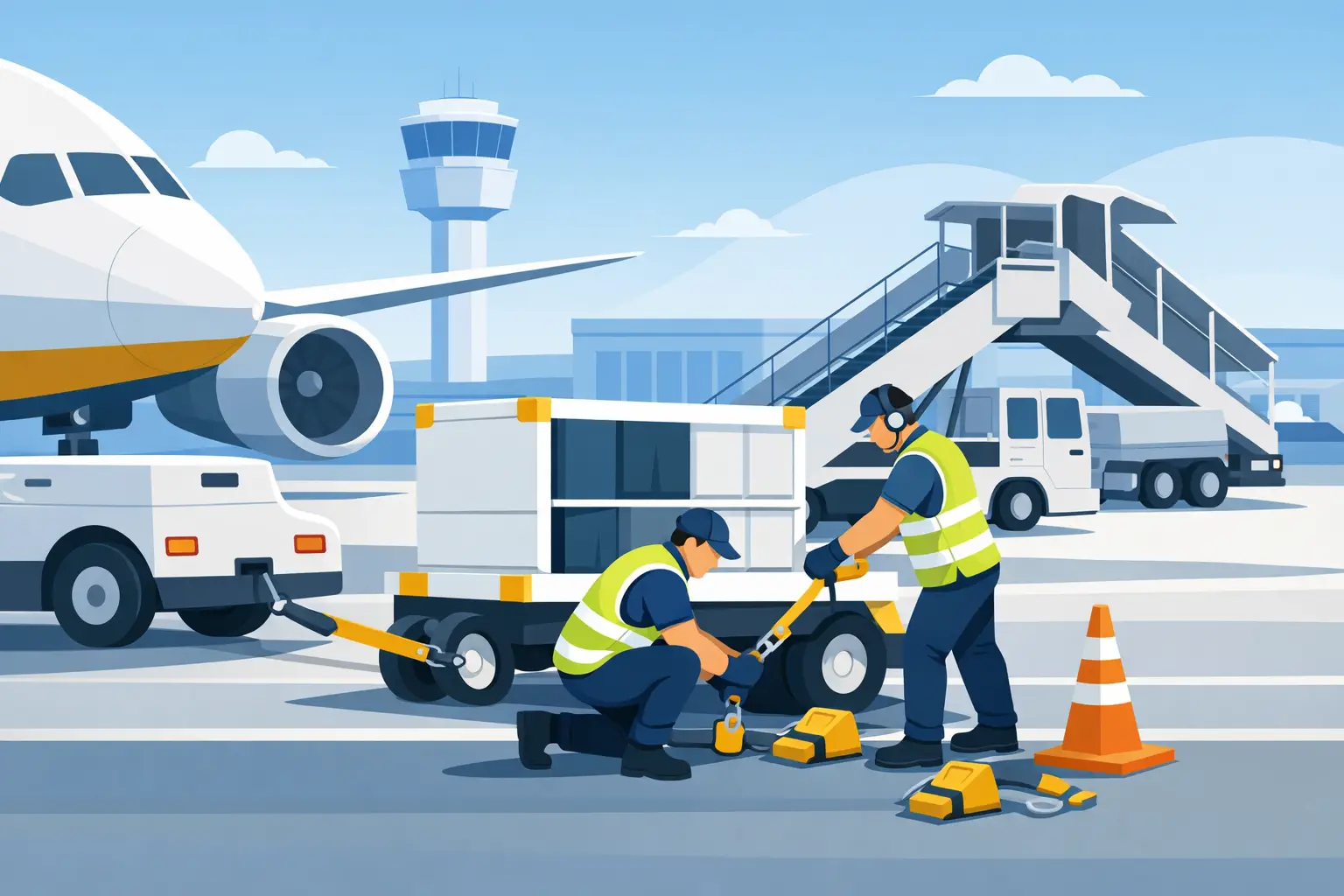
Engineered polyurethane offers a useful balance for many GSE applications: low weight, high strength, resistance to repeated impact, and a non-damaging contact surface. It can also reduce the manual effort required to carry, place, and retrieve restraints across a shift. That benefit is operational, not merely ergonomic. When equipment is easier to use correctly, consistent deployment is more likely.
Rosén Innovation develops Swedish-made polyurethane chocks around this practical requirement: lighter equipment for the handler, dependable support for the vehicle, and recyclable material choices for professional operations. Selection still needs to be based on the specific tire, load, and procedure, not just the product material.
A reliable process reduces ambiguity. Before approaching the wheel, ensure the equipment is fully stopped and parked in its approved service position. The operator should apply the parking brake and, where required, place the transmission or drive selector in the prescribed setting. Never place hands, feet, or a chock in the path of a rolling wheel.
Approach from a safe position and place the restraint tightly against the tire at the designated point. Do not throw a chock toward the wheel or leave a gap that allows momentum to build before contact. If the equipment has moved after the brake was applied, reposition it safely before installing the restraint. For dual-wheel or multi-axle equipment, follow the equipment-specific requirement rather than assuming one chock is enough.
Once installed, perform a visual confirmation. The chock should sit flat on the pavement, make firm tire contact, and remain clear of hoses, cables, doors, moving components, and pedestrian routes. A chock positioned beneath a protruding component or partly on debris is not correctly deployed, even if it initially appears to hold.
Removal deserves the same discipline. First confirm that the operator is in position, the area is clear, and the equipment is ready to move under controlled conditions. Remove restraints only on the authorized signal or according to the local release sequence. A common failure point is removing chocks while another team member is still working around the vehicle or while an aircraft connection remains in place.
Chocks are often treated as simple consumables, but damaged restraints can create false confidence. Inspect them routinely for cracks, deep cuts, permanent deformation, excessive wear at the tire-contact face, contamination, and missing handles or attachment points. A damaged chock should be removed from service rather than left in the equipment pool for the next shift.
Storage also affects availability. If chocks are scattered across the ramp, left in vehicle cabs, or stored where they collect water and debris, operators may skip the step when time is tight. Assign fixed storage positions on equipment or at service areas. The goal is immediate access without creating a trip hazard or allowing the restraint to fall during travel.
Training should cover more than the instruction to “use chocks.” Teams need to understand which equipment requires restraint, where the correct contact points are, how slope changes placement, and when a damaged or incorrectly sized item must be replaced. Supervisors can reinforce the standard with short observational checks during normal operations rather than relying only on classroom refreshers.
The most frequent restraint failures are procedural. Operators may rely on the parking brake alone, use one undersized chock because the correct pair is unavailable, place a chock with a visible gap, or use an improvised item that has not been approved for the load. These shortcuts save seconds and can create hours of disruption after an incident.
Another issue is treating all ramp equipment as identical. A fleet may include electric tugs, diesel tractors, belt loaders, passenger stairs, lavatory service units, and maintenance vehicles, each with different tire sizes, center-of-gravity characteristics, and working locations. A restraint program should map the right product and quantity to each equipment class. Clear identification, such as size marking or assigned storage, helps operators make the correct choice without delay.
Seasonal changes should be included in that program. Wet-weather ramp inspections, winter checks, and reviews after pavement resurfacing can reveal conditions that warrant updated instructions or different restraint configurations. If a team repeatedly sees chocks shifting, the answer is not to push harder on the same process. Review tire fit, chock geometry, ground condition, loading practice, and compliance with the approved procedure.
The best GSE restraint system is one that works under pressure. It gives operators the correct size at the point of use, makes the restrained condition visible, reduces unnecessary lifting effort, and stands up to repeated contact with tires and pavement. That combination supports safer aircraft servicing without slowing the ramp with complicated workarounds.
For purchasing teams, the decision should be based on documented application fit, material performance, handling weight, durability, and availability for the fleet. For ramp leaders, the priority is consistent use and fast correction when the conditions do not match the plan. A correctly selected restraint, placed correctly every time, gives the entire work area one less movement risk to manage.
">
A parked belt loader, tug, GPU, or service vehicle can become a ramp hazard the moment it moves unexpectedly. GSE restraint deployment is the practical control that keeps ground-support equipment where the operator placed it while aircraft servicing, loading, maintenance, or turnaround work is underway. It is a small task with direct consequences for people, aircraft skin, cargo doors, hoses, couplings, and schedules.
The right restraint is not selected by habit alone. Equipment weight, tire diameter, ramp gradient, surface condition, weather, operating procedure, and clearance to the aircraft all affect the correct deployment method. A lightweight chock may reduce carrying strain and speed up routine work, but it still has to fit the wheel and resist movement under the actual conditions at the stand.
Ground-support equipment operates close to high-value assets and busy work zones. A few inches of uncontrolled rolling can put a bumper into an aircraft fuselage, pull a connected cable or hose, or place a worker between moving equipment and a fixed object. Parking brakes are necessary, but they are not a complete restraint strategy. Brake condition, hydraulic loss, operator error, vibration, slope, and changing loads can all affect holding performance.
Chocks and other physical restraints provide a visible, independent barrier to wheel movement. They also make the parked condition easier to verify during handovers. An arriving shift can see whether equipment is secured rather than assuming that a brake has been set correctly.
The standard should be simple enough to follow during a tight turnaround: park in the approved position, apply the parking brake, confirm equipment clearance, install the specified restraint, and verify that it is seated firmly against the tire. The exact sequence should always follow the airport, operator, and equipment manufacturer procedures in force at that location.
There is no single chock size that suits every GSE fleet. A compact chock that works well on a baggage cart may be undersized for a loaded catering truck. A large, heavy restraint may provide capacity but create unnecessary handling strain for teams that need to deploy it repeatedly throughout the day.
Start with the tire. The chock profile must contact the tire securely, with a face angle and height appropriate to the wheel diameter. A poor fit can allow the tire to climb the restraint instead of being stopped by it. Width also matters. The chock should provide stable contact across the tire without becoming impractical to position in restricted spaces.
Then consider the equipment's mass and loaded state. A tug without a connected load, a fully loaded belt loader, and a fuel service vehicle do not create the same restraint demand. The direction of potential movement matters as well. On level pavement, chocking the designated wheel position may be sufficient under local procedures. On a gradient, the downhill side requires particular attention, and the approved placement may change based on the equipment orientation.
Surface conditions can change the calculation. Smooth painted concrete, wet asphalt, loose debris, frost, fuel residue, and rubber contamination may reduce traction between the chock and the ground. A restraint that performs well in a dry workshop may behave differently on an exposed ramp during winter operations. For this reason, teams should not treat chock deployment as a one-time fit check. The contact area and pavement condition need a quick visual assessment each time.
Material is not a cosmetic specification. Traditional metal chocks can be durable, but they add weight, can damage surfaces, and may become difficult to handle in cold or wet conditions. Hard plastic designs may be light but can crack or lose performance under repeated heavy-duty use, depending on the formulation and application.
Engineered polyurethane offers a useful balance for many GSE applications: low weight, high strength, resistance to repeated impact, and a non-damaging contact surface. It can also reduce the manual effort required to carry, place, and retrieve restraints across a shift. That benefit is operational, not merely ergonomic. When equipment is easier to use correctly, consistent deployment is more likely.
Rosén Innovation develops Swedish-made polyurethane chocks around this practical requirement: lighter equipment for the handler, dependable support for the vehicle, and recyclable material choices for professional operations. Selection still needs to be based on the specific tire, load, and procedure, not just the product material.
A reliable process reduces ambiguity. Before approaching the wheel, ensure the equipment is fully stopped and parked in its approved service position. The operator should apply the parking brake and, where required, place the transmission or drive selector in the prescribed setting. Never place hands, feet, or a chock in the path of a rolling wheel.
Approach from a safe position and place the restraint tightly against the tire at the designated point. Do not throw a chock toward the wheel or leave a gap that allows momentum to build before contact. If the equipment has moved after the brake was applied, reposition it safely before installing the restraint. For dual-wheel or multi-axle equipment, follow the equipment-specific requirement rather than assuming one chock is enough.
Once installed, perform a visual confirmation. The chock should sit flat on the pavement, make firm tire contact, and remain clear of hoses, cables, doors, moving components, and pedestrian routes. A chock positioned beneath a protruding component or partly on debris is not correctly deployed, even if it initially appears to hold.
Removal deserves the same discipline. First confirm that the operator is in position, the area is clear, and the equipment is ready to move under controlled conditions. Remove restraints only on the authorized signal or according to the local release sequence. A common failure point is removing chocks while another team member is still working around the vehicle or while an aircraft connection remains in place.
Chocks are often treated as simple consumables, but damaged restraints can create false confidence. Inspect them routinely for cracks, deep cuts, permanent deformation, excessive wear at the tire-contact face, contamination, and missing handles or attachment points. A damaged chock should be removed from service rather than left in the equipment pool for the next shift.
Storage also affects availability. If chocks are scattered across the ramp, left in vehicle cabs, or stored where they collect water and debris, operators may skip the step when time is tight. Assign fixed storage positions on equipment or at service areas. The goal is immediate access without creating a trip hazard or allowing the restraint to fall during travel.
Training should cover more than the instruction to “use chocks.” Teams need to understand which equipment requires restraint, where the correct contact points are, how slope changes placement, and when a damaged or incorrectly sized item must be replaced. Supervisors can reinforce the standard with short observational checks during normal operations rather than relying only on classroom refreshers.
The most frequent restraint failures are procedural. Operators may rely on the parking brake alone, use one undersized chock because the correct pair is unavailable, place a chock with a visible gap, or use an improvised item that has not been approved for the load. These shortcuts save seconds and can create hours of disruption after an incident.
Another issue is treating all ramp equipment as identical. A fleet may include electric tugs, diesel tractors, belt loaders, passenger stairs, lavatory service units, and maintenance vehicles, each with different tire sizes, center-of-gravity characteristics, and working locations. A restraint program should map the right product and quantity to each equipment class. Clear identification, such as size marking or assigned storage, helps operators make the correct choice without delay.
Seasonal changes should be included in that program. Wet-weather ramp inspections, winter checks, and reviews after pavement resurfacing can reveal conditions that warrant updated instructions or different restraint configurations. If a team repeatedly sees chocks shifting, the answer is not to push harder on the same process. Review tire fit, chock geometry, ground condition, loading practice, and compliance with the approved procedure.
The best GSE restraint system is one that works under pressure. It gives operators the correct size at the point of use, makes the restrained condition visible, reduces unnecessary lifting effort, and stands up to repeated contact with tires and pavement. That combination supports safer aircraft servicing without slowing the ramp with complicated workarounds.
For purchasing teams, the decision should be based on documented application fit, material performance, handling weight, durability, and availability for the fleet. For ramp leaders, the priority is consistent use and fast correction when the conditions do not match the plan. A correctly selected restraint, placed correctly every time, gives the entire work area one less movement risk to manage.