
Cart
Your cart is empty, but doesn't have to be..
Your cart is empty, but doesn't have to be..
Rosén Innovation COM |26/07, 2026
snow-prone loading entrance needs serious water handling. A dry manufacturing environment may need stronger grit removal and resistance to industrial dust. A customer-facing lobby must balance performance with a clean, consistent presentation.
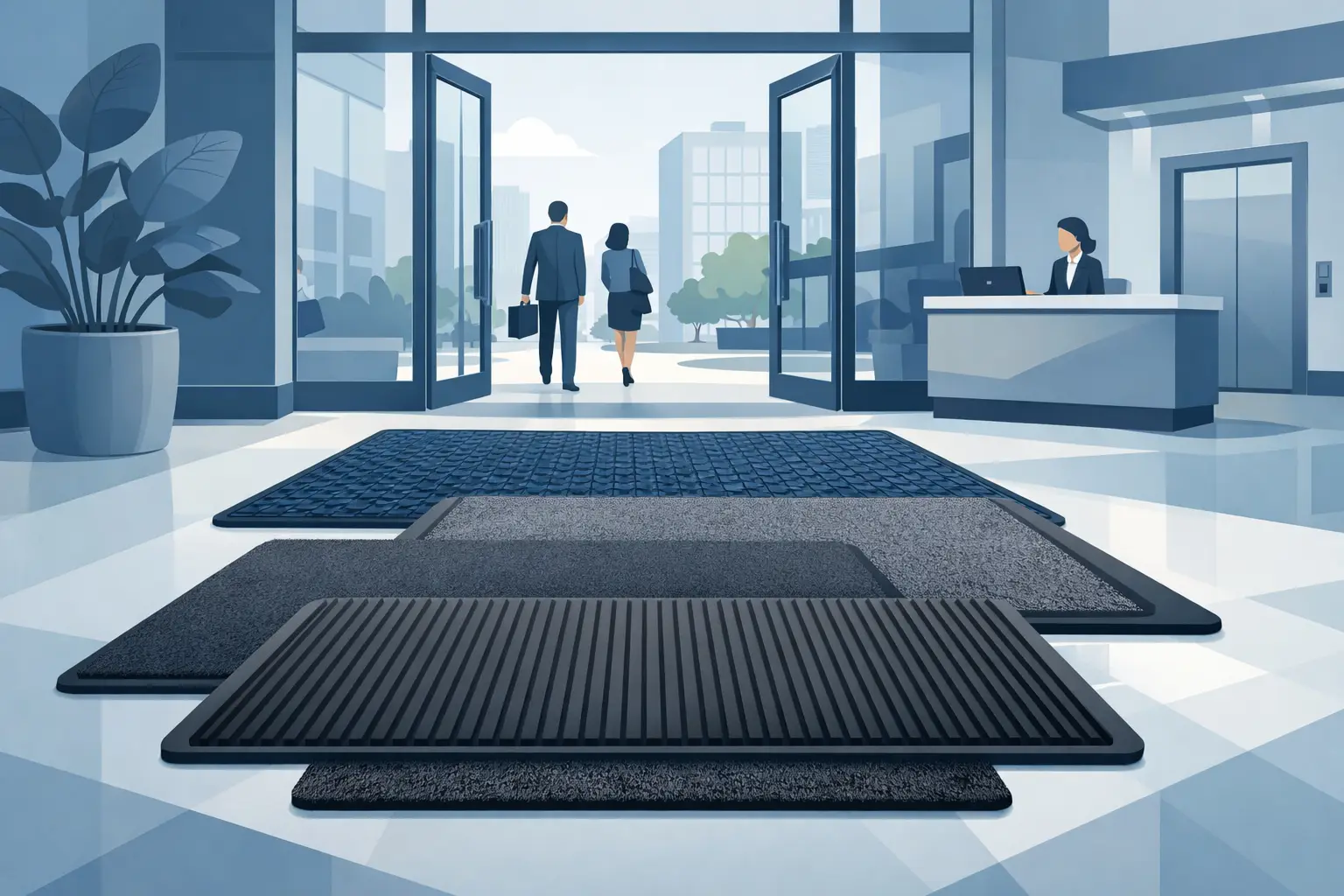
The most effective commercial entrances use zones. Each zone performs a different task, so employees, visitors, and rolling traffic have a better chance to shed contamination before reaching the main floor.
The exterior section should tolerate rain, temperature swings, grit, and heavy shoe soles. Its primary job is aggressive scraping. Open-grid rubber designs can allow water and loose debris to pass through rather than remain on the walking surface. They are useful near loading doors, workshops, garages, and other entries where mud, gravel, or snow are common.
Exterior mats must also stay in place. An undersized lightweight mat can curl, migrate, or lift at the edges, creating the hazard it was intended to prevent. Match the mat construction to the surface below it and avoid products that cannot handle direct weather exposure.
The indoor section should remove finer dust and absorb moisture that remains after the exterior scraping zone. Textile-topped or high-capacity surface materials are often suitable here because they hold water while maintaining a walkable surface. Ribbed patterns can direct shoe contact across the pile and help reduce tracking.
This zone is especially valuable where hard interior floors are exposed to wet weather. Water that makes it past the doorway can spread quickly through foot traffic and create a much larger slip area. A properly sized mat section contains that problem near the entrance, where it can be cleaned on schedule.
Some entrances need more than two zones. A long corridor from a parking area, an industrial changing room, or a vestibule serving shift changes may require additional runner length. The goal is to keep people on matting for enough steps to remove moisture and debris effectively.
There is no universal length that fits every property. Traffic speed, available space, weather, and the amount of contamination all matter. As a practical rule, short mats suit low-traffic, sheltered doors; busy entrances and wet environments need more coverage. If the floor beyond the mat is repeatedly dirty or wet, the mat system is too short, too narrow, or not suited to the contamination.
Material selection determines how a mat handles loading, cleaning, water, chemicals, and temperature changes. It should be based on the operating environment rather than a general claim of durability.
Rubber is a practical choice for harsh, wet, and debris-heavy areas. It provides grip, stands up well to repeated use, and can be cleaned with relative ease. Rubber surfaces are commonly used where boots, carts, and equipment move between outdoor and indoor work zones. However, rubber alone may not absorb the amount of water needed for a polished lobby floor, so it often works best as part of a zoned system.
Polyurethane offers another option when low weight, durability, resilience, and recyclability are important. In industrial applications, material design matters because a product must resist deformation while remaining manageable to move, clean, and replace. Rosén Innovation applies this Swedish-made polyurethane expertise across demanding safety and workplace products, where high strength and lower weight support daily operations.
Textile or fiber surfaces are effective for moisture capture and fine-dust control, particularly in offices, healthcare settings, hotels, and customer entrances. Their trade-off is maintenance. They need regular vacuuming and periodic deep cleaning to retain their capacity. A mat that is saturated or packed with soil cannot continue protecting the floor.
A mat that is too small encourages people to step around it. This is common at double doors, wide reception entries, and loading-access doors where traffic naturally spreads across the full opening. Commercial entrance floor mats should cover the path people actually use, not just the centerline of the doorway.
Measure the clear opening, the likely direction of travel, and the area required for door swing. For wide entries, use sections that create continuous coverage without large gaps. For rolling carts, wheelchairs, pallet jacks, or service equipment, ensure edges are low-profile and securely positioned. Thick loose edges can interfere with wheels, while high transitions can become trip points.
Recessed mat wells can provide a clean, flush installation in new construction or renovation projects. They protect edges and reduce movement, but they require accurate depth, drainage planning, and a mat designed for the recess. Surface-laid mats are faster to install and easier to replace, making them suitable for many existing facilities. The correct option depends on the floor assembly and whether the entrance is being built, upgraded, or maintained under a limited downtime window.
Even the strongest mat fails if cleaning is treated as an afterthought. Entrance mats work by holding contamination, which means they need a defined maintenance cycle. Dry debris should be vacuumed or shaken out frequently. Wet conditions may require extraction, washing, or mat rotation so the surface can dry fully.
Set the schedule according to conditions, not only the calendar. During snow, rain, construction work, or seasonal leaf drop, an entrance may need attention several times per day. In a dry office environment, less frequent service may be enough. Facility teams should inspect mats for curled edges, backing damage, flattened pile, oversaturation, and movement across the floor.
Replacement is also a normal operating cost. A worn mat can look acceptable while performing poorly. If it no longer scrapes footwear, absorbs moisture, lies flat, or stays stable under traffic, it has reached the end of its useful service life.
The most expensive mistake is buying by unit price alone. A low-cost mat that needs frequent replacement or allows dirt to damage flooring can cost more than a properly selected commercial product. Another common error is installing the same material inside and outside despite very different exposure conditions.
Buyers also underestimate edge design, backing, and cleaning compatibility. A mat may perform well in a showroom but fail in service if its backing slides on sealed concrete, its surface cannot be cleaned with available equipment, or its dimensions do not accommodate wheeled traffic. Requesting the correct size, thickness, material, and intended application at the start prevents avoidable replacements.
A good entrance mat should quietly reduce problems: fewer wet-floor incidents, less tracked-in grit, cleaner interiors, and less strain on cleaning staff. Start by observing what reaches the door during the worst week of the year, then specify the mat system for that reality rather than for a dry, low-traffic day.
">
A facility entrance can carry more dirt, water, road salt, grit, and oil in a single wet shift than a cleaning team should have to chase across the building. Commercial entrance floor mats are the first working surface inside that door. When specified correctly, they capture contamination where it enters, improve footing, protect finished flooring, and reduce the labor required to keep public and work areas presentable.
For a warehouse, repair shop, healthcare facility, office building, airport support area, or retail entrance, the best choice is rarely a single thin mat placed just inside the door. Effective entrance protection is a system matched to traffic volume, local weather, floor construction, cleaning routines, and the type of contamination people and equipment bring indoors.
An entrance mat has a practical job: remove and retain debris before it reaches interior surfaces. That means collecting dry soil from shoes and wheels, absorbing or channeling moisture, and maintaining enough traction that the mat itself does not become a slip risk.
This is why appearance alone is a poor buying criterion. A decorative mat may look acceptable on day one but flatten quickly under carts, rolling equipment, work boots, or thousands of daily footfalls. Once its surface is compressed, it loses scraping action and water capacity. Dirt then moves beyond the entry and into grout lines, carpet fibers, polished concrete, epoxy coatings, and workshop floors.
For professional buyers, the specification should focus on four outcomes: soil removal, moisture control, stable footing, and service life. The priority among them depends on the facility. A snow-prone loading entrance needs serious water handling. A dry manufacturing environment may need stronger grit removal and resistance to industrial dust. A customer-facing lobby must balance performance with a clean, consistent presentation.
The most effective commercial entrances use zones. Each zone performs a different task, so employees, visitors, and rolling traffic have a better chance to shed contamination before reaching the main floor.
The exterior section should tolerate rain, temperature swings, grit, and heavy shoe soles. Its primary job is aggressive scraping. Open-grid rubber designs can allow water and loose debris to pass through rather than remain on the walking surface. They are useful near loading doors, workshops, garages, and other entries where mud, gravel, or snow are common.
Exterior mats must also stay in place. An undersized lightweight mat can curl, migrate, or lift at the edges, creating the hazard it was intended to prevent. Match the mat construction to the surface below it and avoid products that cannot handle direct weather exposure.
The indoor section should remove finer dust and absorb moisture that remains after the exterior scraping zone. Textile-topped or high-capacity surface materials are often suitable here because they hold water while maintaining a walkable surface. Ribbed patterns can direct shoe contact across the pile and help reduce tracking.
This zone is especially valuable where hard interior floors are exposed to wet weather. Water that makes it past the doorway can spread quickly through foot traffic and create a much larger slip area. A properly sized mat section contains that problem near the entrance, where it can be cleaned on schedule.
Some entrances need more than two zones. A long corridor from a parking area, an industrial changing room, or a vestibule serving shift changes may require additional runner length. The goal is to keep people on matting for enough steps to remove moisture and debris effectively.
There is no universal length that fits every property. Traffic speed, available space, weather, and the amount of contamination all matter. As a practical rule, short mats suit low-traffic, sheltered doors; busy entrances and wet environments need more coverage. If the floor beyond the mat is repeatedly dirty or wet, the mat system is too short, too narrow, or not suited to the contamination.
Material selection determines how a mat handles loading, cleaning, water, chemicals, and temperature changes. It should be based on the operating environment rather than a general claim of durability.
Rubber is a practical choice for harsh, wet, and debris-heavy areas. It provides grip, stands up well to repeated use, and can be cleaned with relative ease. Rubber surfaces are commonly used where boots, carts, and equipment move between outdoor and indoor work zones. However, rubber alone may not absorb the amount of water needed for a polished lobby floor, so it often works best as part of a zoned system.
Polyurethane offers another option when low weight, durability, resilience, and recyclability are important. In industrial applications, material design matters because a product must resist deformation while remaining manageable to move, clean, and replace. Rosén Innovation applies this Swedish-made polyurethane expertise across demanding safety and workplace products, where high strength and lower weight support daily operations.
Textile or fiber surfaces are effective for moisture capture and fine-dust control, particularly in offices, healthcare settings, hotels, and customer entrances. Their trade-off is maintenance. They need regular vacuuming and periodic deep cleaning to retain their capacity. A mat that is saturated or packed with soil cannot continue protecting the floor.
A mat that is too small encourages people to step around it. This is common at double doors, wide reception entries, and loading-access doors where traffic naturally spreads across the full opening. Commercial entrance floor mats should cover the path people actually use, not just the centerline of the doorway.
Measure the clear opening, the likely direction of travel, and the area required for door swing. For wide entries, use sections that create continuous coverage without large gaps. For rolling carts, wheelchairs, pallet jacks, or service equipment, ensure edges are low-profile and securely positioned. Thick loose edges can interfere with wheels, while high transitions can become trip points.
Recessed mat wells can provide a clean, flush installation in new construction or renovation projects. They protect edges and reduce movement, but they require accurate depth, drainage planning, and a mat designed for the recess. Surface-laid mats are faster to install and easier to replace, making them suitable for many existing facilities. The correct option depends on the floor assembly and whether the entrance is being built, upgraded, or maintained under a limited downtime window.
Even the strongest mat fails if cleaning is treated as an afterthought. Entrance mats work by holding contamination, which means they need a defined maintenance cycle. Dry debris should be vacuumed or shaken out frequently. Wet conditions may require extraction, washing, or mat rotation so the surface can dry fully.
Set the schedule according to conditions, not only the calendar. During snow, rain, construction work, or seasonal leaf drop, an entrance may need attention several times per day. In a dry office environment, less frequent service may be enough. Facility teams should inspect mats for curled edges, backing damage, flattened pile, oversaturation, and movement across the floor.
Replacement is also a normal operating cost. A worn mat can look acceptable while performing poorly. If it no longer scrapes footwear, absorbs moisture, lies flat, or stays stable under traffic, it has reached the end of its useful service life.
The most expensive mistake is buying by unit price alone. A low-cost mat that needs frequent replacement or allows dirt to damage flooring can cost more than a properly selected commercial product. Another common error is installing the same material inside and outside despite very different exposure conditions.
Buyers also underestimate edge design, backing, and cleaning compatibility. A mat may perform well in a showroom but fail in service if its backing slides on sealed concrete, its surface cannot be cleaned with available equipment, or its dimensions do not accommodate wheeled traffic. Requesting the correct size, thickness, material, and intended application at the start prevents avoidable replacements.
A good entrance mat should quietly reduce problems: fewer wet-floor incidents, less tracked-in grit, cleaner interiors, and less strain on cleaning staff. Start by observing what reaches the door during the worst week of the year, then specify the mat system for that reality rather than for a dry, low-traffic day.