
Cart
Your cart is empty, but doesn't have to be..
Your cart is empty, but doesn't have to be..
Rosén Innovation COM |20/08, 2026
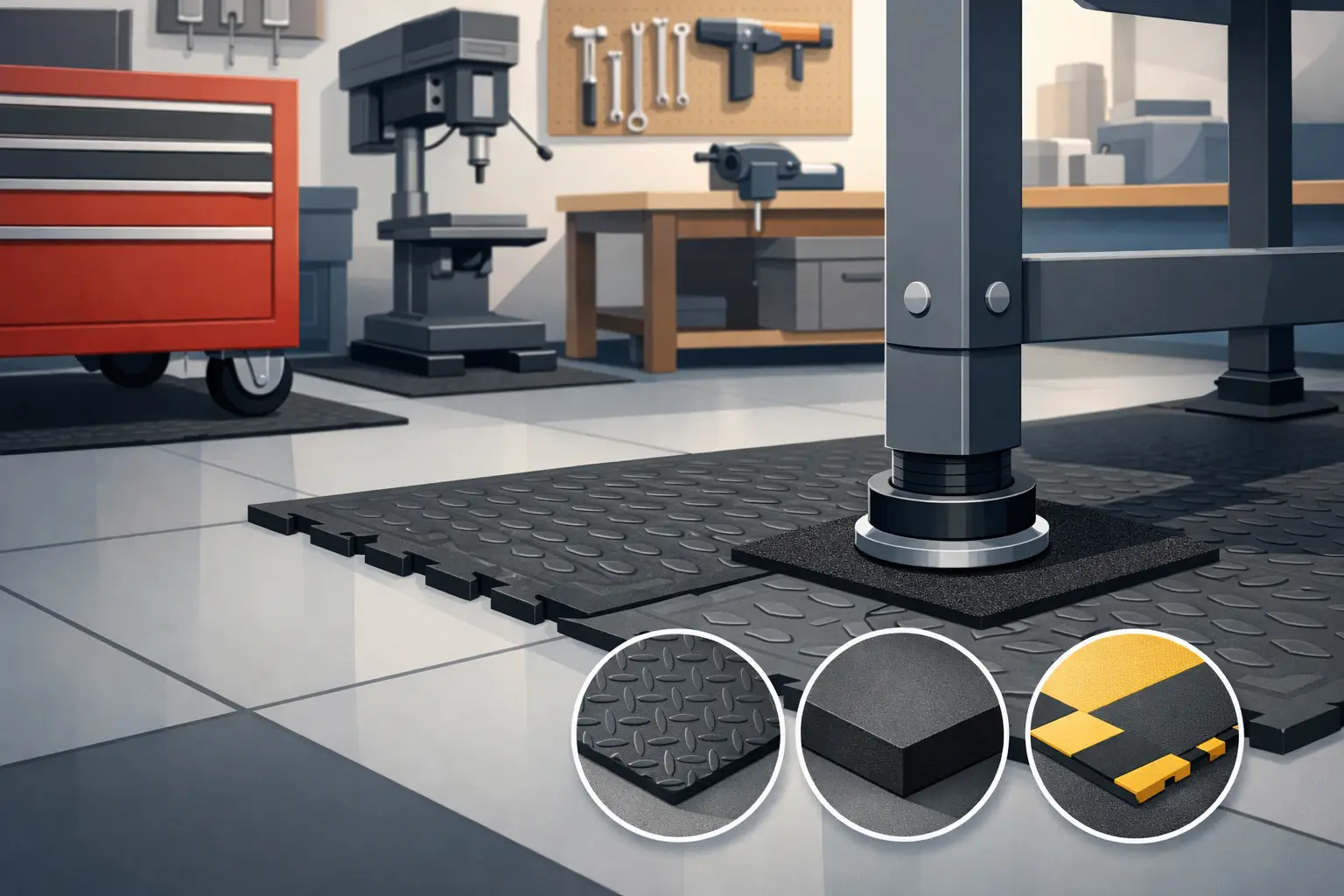
polyurethane pads and plates are often the strongest practical option. Polyurethane combines high load capacity with enough resilience to protect the floor and reduce metal-on-concrete contact. It is lighter than comparable steel components, does not rust, and can be manufactured in defined sizes and thicknesses for repeatable placement.
This is the preferred route when the protector must carry heavy, repeated loads without permanent flattening. A properly sized plate distributes pressure across a larger floor area, reducing the risk of indenting coatings or damaging weak concrete. It can also reduce noise and vibration from metal equipment.
Density and geometry are critical. A small, hard pad may still overload the surface below it. A plate that is too thin can flex or curl at the edge. For lifting equipment, use pads designed for that specific purpose and confirm that they do not affect lift stability, manufacturer-required clearances, or safe operating procedures. Floor protection must never be used to compensate for an unstable lift or damaged concrete.
Rubber is a practical choice under lighter stationary equipment, benches, compressors, cabinets, and carts that stay in one place. It offers good grip and vibration damping, and it can help reduce movement on smooth floors. Thicker rubber products can also protect finished floors from abrasion and minor impact.
The trade-off is compression and chemical resistance. Some rubber compounds soften, swell, or degrade when exposed to petroleum products, solvents, or aggressive cleaning agents. Under high point loads, rubber can compress over time and allow an equipment foot to mark the floor. Specify the rubber compound for the environment instead of treating all black rubber pads as equal.
Rubber also works well where vibration and noise are the primary concern. For a compressor room or a bench-mounted machine, a non-slip rubber pad can reduce transmitted vibration while keeping the installation simple. It is less suitable beneath heavily loaded vehicle-lift feet unless the pad has been engineered and rated for that duty.
At a service counter, assembly cell, inspection bench, or packing station, the floor protector should reduce strain on people rather than carry major equipment loads. Anti-fatigue mats provide a cushioned standing surface that can help reduce discomfort during long shifts. They also define work areas and can improve traction in dry or lightly wet conditions.
Choose mats with beveled edges to limit trip risk and a surface pattern that can be cleaned without trapping metal shavings. In welding, grinding, or hot-work areas, material selection requires extra care. Many standard mats are not suitable around sparks, hot swarf, or welding spatter. For oil-prone bays, select a mat formulated for oil resistance and inspect it regularly for curled edges or contamination.
Do not place anti-fatigue mats where floor jacks, creepers, carts, or rolling toolboxes need to move freely. A mat that improves comfort at a bench can become an obstruction in a traffic lane.
Forklift staging areas need a different approach. The main risk is not only vertical weight but repeated wheel loading, turning, braking, and pallet impacts. Loose pads can migrate, while soft products can tear at their edges. For these applications, use heavy-duty plates or purpose-built protective elements that remain stable under rolling traffic.
If forklifts cross the area continuously, it may be better to protect the floor with a permanent industrial coating or repair system rather than portable protectors. Portable polyurethane blocks or plates are most useful at fixed parking positions, under stabilizers, beneath special loads, or at known high-wear points. Mark the location so operators return equipment to the intended contact area.
The best choice begins with measurements, not a generic description such as “heavy-duty.” Measure the equipment foot, wheel, or contact point. Then consider the total load, how that load is distributed, whether it is static or dynamic, and the floor condition. A pad should extend beyond the contact point sufficiently to spread the load while remaining flat and stable.
Use these four checks before ordering:
For many workshops, polyurethane offers the best balance of strength, low weight, longevity, and recyclability. Swedish-made polyurethane products from Rosén Innovation are designed around exactly these industrial requirements: repeated use, high strength, practical handling, and protection where metal equipment meets a working surface. Still, material alone does not guarantee performance. The dimensions, hardness, and application must be correct.
The first mistake is using scrap wood. It may seem economical, but wood absorbs moisture and oil, splinters under load, varies in thickness, and can hide cracks. It is not a controlled or repeatable safety component.
The second is selecting a protector based only on thickness. A thick soft mat can be less effective under a concentrated load than a thinner, dense plate. Hardness, load distribution, and edge stability determine whether the product stays functional.
Another frequent issue is ignoring housekeeping. Grit under a pad, oil on its surface, or a curled edge changes its performance. Clean both sides before placement and inspect high-load protectors as part of normal equipment checks. Replace any product showing deep cuts, cracking, permanent deformation, or loss of grip.
Finally, do not use floor protectors to hide a structural problem. If concrete is cracked, delaminated, or sinking, assess and repair the floor. A pad can reduce contact stress, but it cannot make an unsafe foundation safe.
The most effective workshop floor protection is easy for technicians to use correctly every time. Keep lift pads near the lift, mark fixed equipment positions, and assign a defined home for portable plates and blocks. If a protector is heavy, awkward, or stored across the shop, it will eventually be skipped.
Standardizing sizes across bays also helps purchasing and maintenance teams. Instead of collecting a mix of improvised materials, keep a small set of purpose-built protectors matched to lifts, jacks, workstations, and fixed equipment. That improves inspection, replacement planning, and safe setup consistency.
A protected floor stays cleaner, safer, and easier to maintain, but the real value is operational control. Specify each contact point correctly, use equipment-rated materials, and make the safe choice the convenient choice on every shift.
">
A vehicle lift can be rated for several tons and still create a preventable floor problem at its smallest contact points. Steel feet, jack stands, rolling equipment, dropped tools, and constant foot traffic all concentrate force where a workshop floor is least protected. The best workshop floor protectors are selected for the actual load, contact surface, and operating routine - not simply for how thick they look.
For automotive service bays, fleet workshops, maintenance departments, and industrial facilities, floor protection is also equipment protection. The right pad or mat reduces slipping, limits chipped coatings and concrete damage, protects sensitive vehicle contact areas, and gives technicians a more stable work surface. The wrong material can creep under load, crack in cold conditions, absorb fluids, or become a trip hazard.
A workshop floor protector is not one product category. Lift-foot pads, jack pads, anti-fatigue mats, equipment blocks, and large polyurethane plates all solve different problems. Buying one material for every area usually creates a compromise: a soft mat may feel good underfoot but cannot safely carry a concentrated lift load, while a hard load pad is not the right answer for an assembly station.
Start by identifying what creates the force. Static equipment places a constant load in one location. Vehicle lifts transfer high force through small feet. Forklifts, carts, and floor jacks add rolling and turning forces that can pull or shear a loose product. Standing workstations introduce an ergonomic requirement, often alongside oil, coolant, water, and cleaning chemicals.
The floor itself matters just as much. Painted concrete and epoxy coatings can be marked or chipped by steel contact points. Smooth sealed concrete may become slippery when contaminated. Older concrete can spall under repeated point loading. A protector should spread the load without trapping grit underneath, because trapped debris can grind into the floor and defeat the purpose.
For vehicle lifts, heavy stands, stabilizers, and machinery feet, dense polyurethane pads and plates are often the strongest practical option. Polyurethane combines high load capacity with enough resilience to protect the floor and reduce metal-on-concrete contact. It is lighter than comparable steel components, does not rust, and can be manufactured in defined sizes and thicknesses for repeatable placement.
This is the preferred route when the protector must carry heavy, repeated loads without permanent flattening. A properly sized plate distributes pressure across a larger floor area, reducing the risk of indenting coatings or damaging weak concrete. It can also reduce noise and vibration from metal equipment.
Density and geometry are critical. A small, hard pad may still overload the surface below it. A plate that is too thin can flex or curl at the edge. For lifting equipment, use pads designed for that specific purpose and confirm that they do not affect lift stability, manufacturer-required clearances, or safe operating procedures. Floor protection must never be used to compensate for an unstable lift or damaged concrete.
Rubber is a practical choice under lighter stationary equipment, benches, compressors, cabinets, and carts that stay in one place. It offers good grip and vibration damping, and it can help reduce movement on smooth floors. Thicker rubber products can also protect finished floors from abrasion and minor impact.
The trade-off is compression and chemical resistance. Some rubber compounds soften, swell, or degrade when exposed to petroleum products, solvents, or aggressive cleaning agents. Under high point loads, rubber can compress over time and allow an equipment foot to mark the floor. Specify the rubber compound for the environment instead of treating all black rubber pads as equal.
Rubber also works well where vibration and noise are the primary concern. For a compressor room or a bench-mounted machine, a non-slip rubber pad can reduce transmitted vibration while keeping the installation simple. It is less suitable beneath heavily loaded vehicle-lift feet unless the pad has been engineered and rated for that duty.
At a service counter, assembly cell, inspection bench, or packing station, the floor protector should reduce strain on people rather than carry major equipment loads. Anti-fatigue mats provide a cushioned standing surface that can help reduce discomfort during long shifts. They also define work areas and can improve traction in dry or lightly wet conditions.
Choose mats with beveled edges to limit trip risk and a surface pattern that can be cleaned without trapping metal shavings. In welding, grinding, or hot-work areas, material selection requires extra care. Many standard mats are not suitable around sparks, hot swarf, or welding spatter. For oil-prone bays, select a mat formulated for oil resistance and inspect it regularly for curled edges or contamination.
Do not place anti-fatigue mats where floor jacks, creepers, carts, or rolling toolboxes need to move freely. A mat that improves comfort at a bench can become an obstruction in a traffic lane.
Forklift staging areas need a different approach. The main risk is not only vertical weight but repeated wheel loading, turning, braking, and pallet impacts. Loose pads can migrate, while soft products can tear at their edges. For these applications, use heavy-duty plates or purpose-built protective elements that remain stable under rolling traffic.
If forklifts cross the area continuously, it may be better to protect the floor with a permanent industrial coating or repair system rather than portable protectors. Portable polyurethane blocks or plates are most useful at fixed parking positions, under stabilizers, beneath special loads, or at known high-wear points. Mark the location so operators return equipment to the intended contact area.
The best choice begins with measurements, not a generic description such as “heavy-duty.” Measure the equipment foot, wheel, or contact point. Then consider the total load, how that load is distributed, whether it is static or dynamic, and the floor condition. A pad should extend beyond the contact point sufficiently to spread the load while remaining flat and stable.
Use these four checks before ordering:
For many workshops, polyurethane offers the best balance of strength, low weight, longevity, and recyclability. Swedish-made polyurethane products from Rosén Innovation are designed around exactly these industrial requirements: repeated use, high strength, practical handling, and protection where metal equipment meets a working surface. Still, material alone does not guarantee performance. The dimensions, hardness, and application must be correct.
The first mistake is using scrap wood. It may seem economical, but wood absorbs moisture and oil, splinters under load, varies in thickness, and can hide cracks. It is not a controlled or repeatable safety component.
The second is selecting a protector based only on thickness. A thick soft mat can be less effective under a concentrated load than a thinner, dense plate. Hardness, load distribution, and edge stability determine whether the product stays functional.
Another frequent issue is ignoring housekeeping. Grit under a pad, oil on its surface, or a curled edge changes its performance. Clean both sides before placement and inspect high-load protectors as part of normal equipment checks. Replace any product showing deep cuts, cracking, permanent deformation, or loss of grip.
Finally, do not use floor protectors to hide a structural problem. If concrete is cracked, delaminated, or sinking, assess and repair the floor. A pad can reduce contact stress, but it cannot make an unsafe foundation safe.
The most effective workshop floor protection is easy for technicians to use correctly every time. Keep lift pads near the lift, mark fixed equipment positions, and assign a defined home for portable plates and blocks. If a protector is heavy, awkward, or stored across the shop, it will eventually be skipped.
Standardizing sizes across bays also helps purchasing and maintenance teams. Instead of collecting a mix of improvised materials, keep a small set of purpose-built protectors matched to lifts, jacks, workstations, and fixed equipment. That improves inspection, replacement planning, and safe setup consistency.
A protected floor stays cleaner, safer, and easier to maintain, but the real value is operational control. Specify each contact point correctly, use equipment-rated materials, and make the safe choice the convenient choice on every shift.