
Cart
Your cart is empty, but doesn't have to be..
Your cart is empty, but doesn't have to be..
Rosén Innovation COM |30/08, 2026
Rope handles and carry solutions should be evaluated for their intended use. A handle makes retrieval easier and can keep hands away from the tire area, but it must not create a snagging hazard or become the only point used to drag a heavily loaded chock. Where chocks are linked as a pair, the connecting element should be durable, correctly sized, and positioned so it does not interfere with tire contact or ramp movement.
At Rosén Innovation, aircraft chocks are developed and made in Sweden around this operating reality: lower handling weight, high strength, clear application fit, and recyclable polyurethane material. Those benefits matter only when the correct size and configuration are chosen for the equipment in service.
Before purchasing, identify the aircraft categories and wheel sizes the chocks will support. Specify whether they are for a single-engine aircraft, helicopter, business jet, airliner, or a mixed fleet. Include ground-support equipment if the same team manages tow tractors, belt loaders, carts, or other vehicles, but do not assume an aircraft chock is automatically suitable for every GSE application.
Ask for the intended tire diameter range, chock dimensions, recommended application, and any load or aircraft-category guidance supplied for the product. Procurement teams should compare these details with their operating manuals rather than selecting only by price or visual size. Transparent dimensions are especially useful when replacing a chock that has already proven effective in the same position.
Also consider storage and fleet standardization. A consistent chock style and color across a station can simplify training, inventory, and visual checks. However, standardization should not force one undersized model across aircraft with fundamentally different wheel and load requirements. A practical program may use several clearly identified sizes, each assigned to a defined aircraft or equipment group.
Even the right chock becomes unreliable when placed on loose debris, standing ice, spilled fluid, or unstable ground. Before chocking, crews should assess the immediate contact area and position the chock firmly against the tire in accordance with site procedure. Do not leave a gap that allows the aircraft to roll before the chock engages. When removing chocks, coordinate with the person controlling aircraft movement and confirm that the area is clear.
A short pre-use inspection catches most preventable failures. Look for four conditions: deep cuts or chunks missing from the wheel contact face; cracking, distortion, or a permanently flattened base; heavy contamination with oil, fuel, ice, or embedded debris; and damaged ropes, handles, or pair connections. Remove a compromised chock from service rather than putting it back into circulation for the next crew.
Cleaning also protects performance. Wipe off fluids and debris using a method compatible with the material and local environmental procedures. Avoid storing chocks where they can be run over, crushed by equipment, exposed to unnecessary heat, or buried beneath loose ramp materials. Polyurethane is durable, but it is not immune to misuse.
The most common error is treating a chock as a simple accessory instead of a load-bearing safety item. That leads to improvised blocks, incorrect sizes, worn equipment remaining in service, and inconsistent placement. Another mistake is choosing the lightest possible chock without checking whether its dimensions and intended application match the aircraft.
Do not confuse low weight with low capacity. Well-engineered polyurethane can deliver significant strength at a lower weight than traditional alternatives. But it needs the correct cross-section, base area, and material specification to do so. Similarly, do not assume a large-looking chock is safer if it does not fit the tire profile or creates poor contact on the ramp.
For mixed operations, document which chocks belong with which aircraft and train crews to recognize the difference. A simple size marking, color system, or storage location can prevent a light-aircraft chock from being carried to a larger aircraft stand during a busy turnaround.
The best next step is straightforward: review the aircraft and ramp conditions you actually support, then select chocks with documented dimensions and intended use to match. A correctly fitted polyurethane chock gives crews a lighter, durable restraint they can trust - shift after shift.
">
A chock that is light enough for a ramp crew to carry all day but fails to hold position is not a safety improvement. The short answer to “are polyurethane chocks aircraft safe” is yes - when the chock is correctly designed, sized, placed, and maintained for the aircraft and operating conditions. Polyurethane is not automatically safer than every alternative. The safety comes from the complete restraint system: material performance, geometry, aircraft compatibility, ramp procedure, and routine inspection.
For aircraft operators, FBOs, MRO teams, and ground handlers, the question is practical. Can the chock hold an aircraft securely during parking, servicing, loading, maintenance, and changing ramp conditions without damaging tires, burdening the crew, or becoming a recurring replacement item? A high-quality polyurethane chock can meet those demands exceptionally well. It must still be selected as carefully as any other piece of ground-support equipment.
Polyurethane combines properties that matter on an active ramp. It can be substantially lighter than comparable solid rubber or metal chocks while retaining high load-bearing strength. That weight reduction is more than a convenience. Crews repeatedly place, retrieve, carry, and store chocks through a shift. Lower handling weight can reduce physical strain and make correct chocking procedures easier to follow consistently.
A properly formulated polyurethane also resists abrasion, tearing, moisture, oils, many fuels, and weather exposure better than materials that crack, absorb fluids, or lose their shape quickly. It maintains a firm contact surface at the tire while providing enough controlled grip to resist sliding on suitable pavement. Unlike metal chocks, polyurethane will not create metal-to-metal contact with the wheel and is less likely to damage floors, hangar surfaces, or aircraft-adjacent equipment if dropped.
Material alone does not determine performance. Polyurethane varies widely by formulation, hardness, resilience, and manufacturing quality. A soft, poorly formed, or undersized polyurethane block is not an aircraft chock simply because it is made from polyurethane. Purpose-built aircraft chocks need a stable base, a wheel-facing profile that matches the tire, and enough mass, contact area, and structural strength for their intended aircraft category.
No chock material is universally correct for every aircraft, surface, or procedure. Polyurethane chocks are safe when the specific model is matched to the tire diameter, aircraft weight, wheel configuration, and ramp environment. They should also be used in line with the aircraft manufacturer's instructions, the operator's ground-handling procedures, and applicable airport or maintenance requirements.
Small chocks may be appropriate for light aircraft, helicopters, and certain ground-support equipment, but they are not interchangeable with chocks used for business jets, regional aircraft, narrowbody airliners, or widebody aircraft. A large aircraft presents higher forces and often requires larger paired chocks with a geometry engineered for its wheel size. Using an undersized chock because it is available is an avoidable safety risk.
Slope changes the decision as well. On a level, clean concrete apron, a correctly fitted chock has a predictable job. On an incline, wet ramp, contaminated surface, or uneven asphalt, the forces and friction conditions change. Operators may require chocks on both sides of one or more wheels, additional restraints, or a different parking position. Chocks support safe parking procedures; they do not replace sound judgment about where and how an aircraft is parked.
Parking brakes are another reason to avoid assumptions. Brakes can cool, pressure can change, and maintenance work may require brake systems to be released. Chocks provide a physical restraint that does not depend on hydraulic pressure or an active brake system. That is why they remain standard equipment around parked aircraft, even where parking brakes are applied.
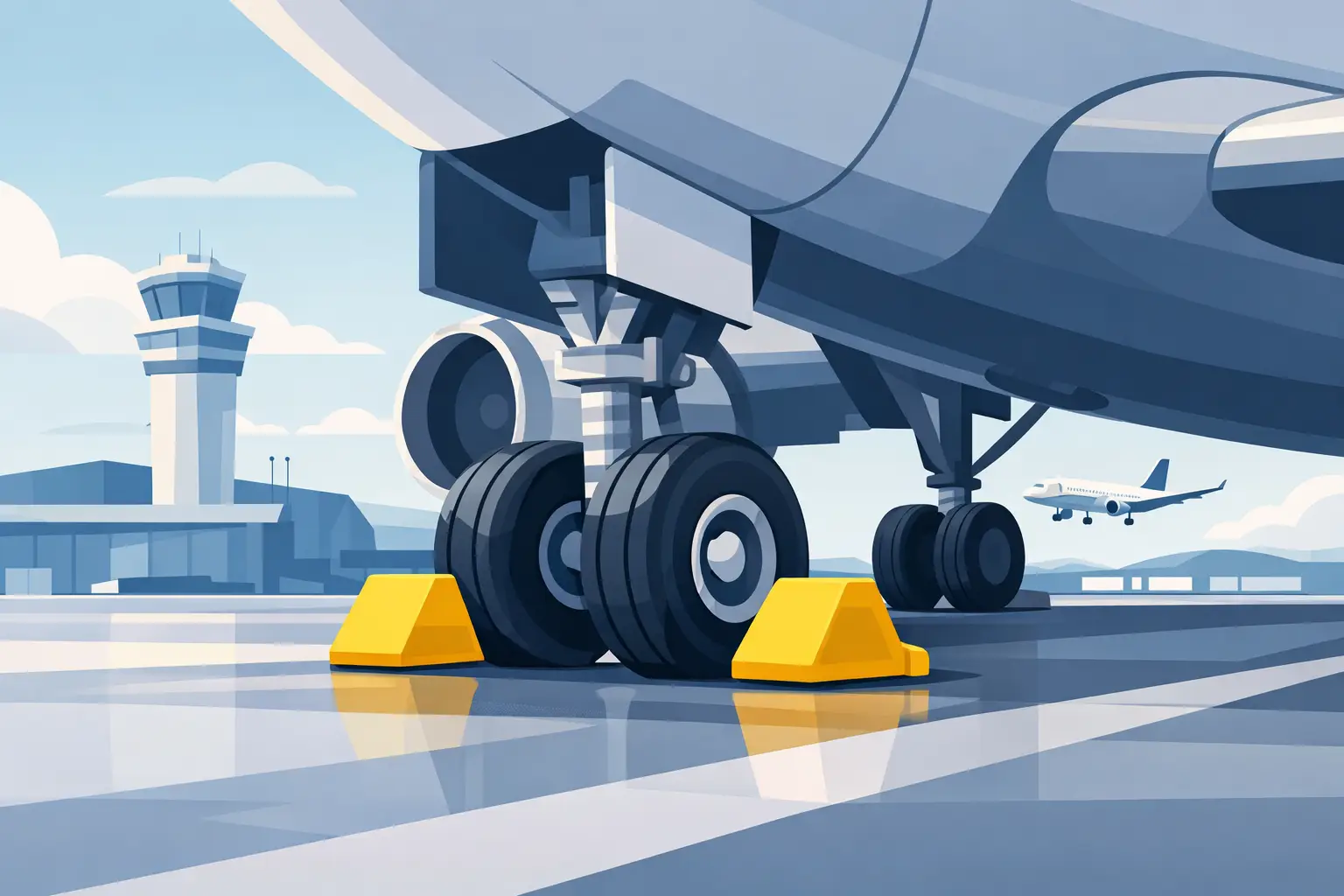
The safest aircraft chock is engineered as a working component, not treated as a generic wedge. Its wheel-facing angle should support the tire without concentrating force on a narrow point. Its base must remain stable rather than rocking or curling at the edges. The chock needs enough width to engage the tire properly, and its height must suit the wheel diameter and anticipated loading.
A visible color is also a practical safety feature. Brightly colored polyurethane chocks are easier for pilots, wing walkers, drivers, and ramp crews to see in low light, rain, or a busy service area. High visibility helps prevent a chock from being left in a hazardous location and supports a clear final walk-around before movement.
Rope handles and carry solutions should be evaluated for their intended use. A handle makes retrieval easier and can keep hands away from the tire area, but it must not create a snagging hazard or become the only point used to drag a heavily loaded chock. Where chocks are linked as a pair, the connecting element should be durable, correctly sized, and positioned so it does not interfere with tire contact or ramp movement.
At Rosén Innovation, aircraft chocks are developed and made in Sweden around this operating reality: lower handling weight, high strength, clear application fit, and recyclable polyurethane material. Those benefits matter only when the correct size and configuration are chosen for the equipment in service.
Before purchasing, identify the aircraft categories and wheel sizes the chocks will support. Specify whether they are for a single-engine aircraft, helicopter, business jet, airliner, or a mixed fleet. Include ground-support equipment if the same team manages tow tractors, belt loaders, carts, or other vehicles, but do not assume an aircraft chock is automatically suitable for every GSE application.
Ask for the intended tire diameter range, chock dimensions, recommended application, and any load or aircraft-category guidance supplied for the product. Procurement teams should compare these details with their operating manuals rather than selecting only by price or visual size. Transparent dimensions are especially useful when replacing a chock that has already proven effective in the same position.
Also consider storage and fleet standardization. A consistent chock style and color across a station can simplify training, inventory, and visual checks. However, standardization should not force one undersized model across aircraft with fundamentally different wheel and load requirements. A practical program may use several clearly identified sizes, each assigned to a defined aircraft or equipment group.
Even the right chock becomes unreliable when placed on loose debris, standing ice, spilled fluid, or unstable ground. Before chocking, crews should assess the immediate contact area and position the chock firmly against the tire in accordance with site procedure. Do not leave a gap that allows the aircraft to roll before the chock engages. When removing chocks, coordinate with the person controlling aircraft movement and confirm that the area is clear.
A short pre-use inspection catches most preventable failures. Look for four conditions: deep cuts or chunks missing from the wheel contact face; cracking, distortion, or a permanently flattened base; heavy contamination with oil, fuel, ice, or embedded debris; and damaged ropes, handles, or pair connections. Remove a compromised chock from service rather than putting it back into circulation for the next crew.
Cleaning also protects performance. Wipe off fluids and debris using a method compatible with the material and local environmental procedures. Avoid storing chocks where they can be run over, crushed by equipment, exposed to unnecessary heat, or buried beneath loose ramp materials. Polyurethane is durable, but it is not immune to misuse.
The most common error is treating a chock as a simple accessory instead of a load-bearing safety item. That leads to improvised blocks, incorrect sizes, worn equipment remaining in service, and inconsistent placement. Another mistake is choosing the lightest possible chock without checking whether its dimensions and intended application match the aircraft.
Do not confuse low weight with low capacity. Well-engineered polyurethane can deliver significant strength at a lower weight than traditional alternatives. But it needs the correct cross-section, base area, and material specification to do so. Similarly, do not assume a large-looking chock is safer if it does not fit the tire profile or creates poor contact on the ramp.
For mixed operations, document which chocks belong with which aircraft and train crews to recognize the difference. A simple size marking, color system, or storage location can prevent a light-aircraft chock from being carried to a larger aircraft stand during a busy turnaround.
The best next step is straightforward: review the aircraft and ramp conditions you actually support, then select chocks with documented dimensions and intended use to match. A correctly fitted polyurethane chock gives crews a lighter, durable restraint they can trust - shift after shift.